When you're a kid, and your parents talk about things that happened twenty, or thirty, or more years ago, it seems like an impossibly long time. Now that it's been an impossibly long time since I was a kid, I find myself saying these sorts of things all the time.*
Large Southern University has been at the center of my life off and on for an improbably long time, given that a younger me once moved 8 times in one year. I found my professional calling there, met my closest friends, learned more than I can even begin to describe. It is as much my home as the house I grew up in.
Later this month I will leave my office for the last time, and start a new adventure in a new place -- one with seasons, terrain, and a single digit student-to-teacher ratio. Biscuit and I will be leaving for the Show Me State, after almost 30 years in Bayou Country. I will be working on a campus that one can see all at one time, after spending most of my life on one that takes 45 minutes to walk across. My new job is 90% teaching, where my current is almost 100% research. I guess what I am saying is, it's going to be different.
I am excited about my new job, and the move. It is closer to family (when did that become a desirable thing?), day trip distance to some of my favorite places, and I love to teach. Did I mention I will be teaching game development? I like games. The town seems nice, and our new house has a garage. And a basement.
As much as I like it when things change, one doesn't live anywhere this long without filling up a life -- at least if you're doing it right. We will miss our friends, and the food, drive-through daiquiri shops, neighborhood parades, Mardi Gras, and much more. Mostly I will miss familiarity. It's good to know where everything is, and the parts of town to avoid when driving there. I've been getting my hair cut by the same person for twenty years (there I go again). This move will mean a new dentist, vet, dry cleaner, and HVAC service company. Restaurants, paint stores, and neighbors all need to be rediscovered and integrated.
Years ago, I was amazed -- and frankly a little concerned -- when my 75 year old father decided to start a new firm. Now I think I get it. Opportunities come when and where they will. We can choose to do what's next, or we can stay planted, clinging to the familiar. For me, it's time for a change. In the words of the immortal Roy McAvoy (Tin Cup), you ride her until she bucks or you don't ride at all.
Wish us luck, and if you're ever in flyover country, stop in for a glass of tea and a shot of white lightning. But definitely call first. I may be out trying to find a front license plate holder.
* Don't even start the "I have underwear older than that" contest. I am simultaneously proud and horrified at how well prepared I am for this game. I really need to clean out my drawers (heh).
Showing posts with label attitude is everything. Show all posts
Showing posts with label attitude is everything. Show all posts
Wednesday, July 6, 2016

Sunday, May 10, 2015
Simple happiness
Final exams were last week, and a few days ago I was contemplating a post to bookend the back to school diatribe I wrote nine months ago. It would have detailed the fundamental and visible ways that the end of the academic year differs from its start. The mood on a rapidly emptying campus is a mix of elation and indifference born of exhaustion. There are no novices on campus now, no wasted steps, and virtually no one is in a hurry. Traffic is practically bearable. Summer's oppressive heat has been replaced with Spring breezes.
This is where it all went wrong. By the next day, when I got serious about writing, it was 89 degrees and humid. The magical state of inspiration was shattered. My disillusionment was beyond what the change in weather alone would dictate. I groused like my grumpiest Facebook friend.
I think this is one reason that grownups can't often achieve the same unabashed happiness that kids get out of five minutes on the merry-go-round.* Adults have complicated lives, with too many degrees of freedom in their bliss equations. Kids don't worry about tomorrow, or regret the road not taken. They are zen, unstable and uncaring. The rest of us bind our happiness to innumerable threads of achievement, entangled and often pulling against each other. Food, shelter, career success, happy and well adjusted children, regard of our peers, romantic bliss, must all coexist before we allow ourselves untainted joy. We must scale to the top of Maslow's pyramid to be unburdened, while an 8 year old is good with a hot dog and 15 minutes in the pool.
I am not sure how much of this behavior is learned, and how much is a natural consequence of the way we are wired. There is a lot of gray matter surrounding the happy place in our brain. I'm sure it's there for some reason. And there is definitely a hormonal component. Self doubt and regret seem to come with puberty.
The good news is that I think the capacity for simple pleasure returns with age. Ask an eighty year old what makes them happy, and they are likely to say a good bowel movement, or a day in the garden. Our family gatherings used to devolve into stress-filled group therapy sessions. These days my family laughs through most of our time together. I have watched my mother's happiness threshold for holidays like Mothers Day moderate from -- unachievable, really -- to lunch and a call from her kids.
So it seems there is hope for us all, even my grumpy Facebook friend. Have a simply happy Mother's Day, everyone.
* I realize merry-go-rounds are much too dangerous for today's children. Do iPad games and Disney shows produce the same giggling elation? A question for another day -- and someone with kids -- I suppose.
This is where it all went wrong. By the next day, when I got serious about writing, it was 89 degrees and humid. The magical state of inspiration was shattered. My disillusionment was beyond what the change in weather alone would dictate. I groused like my grumpiest Facebook friend.
I think this is one reason that grownups can't often achieve the same unabashed happiness that kids get out of five minutes on the merry-go-round.* Adults have complicated lives, with too many degrees of freedom in their bliss equations. Kids don't worry about tomorrow, or regret the road not taken. They are zen, unstable and uncaring. The rest of us bind our happiness to innumerable threads of achievement, entangled and often pulling against each other. Food, shelter, career success, happy and well adjusted children, regard of our peers, romantic bliss, must all coexist before we allow ourselves untainted joy. We must scale to the top of Maslow's pyramid to be unburdened, while an 8 year old is good with a hot dog and 15 minutes in the pool.
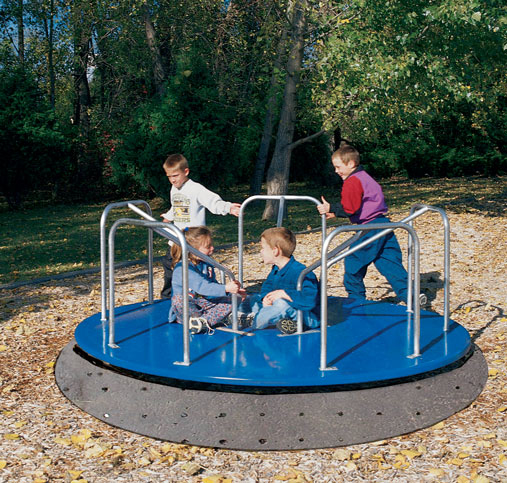 |
| The playground may be rubber, but at least none of these kids are texting. Image from here |
I am not sure how much of this behavior is learned, and how much is a natural consequence of the way we are wired. There is a lot of gray matter surrounding the happy place in our brain. I'm sure it's there for some reason. And there is definitely a hormonal component. Self doubt and regret seem to come with puberty.
The good news is that I think the capacity for simple pleasure returns with age. Ask an eighty year old what makes them happy, and they are likely to say a good bowel movement, or a day in the garden. Our family gatherings used to devolve into stress-filled group therapy sessions. These days my family laughs through most of our time together. I have watched my mother's happiness threshold for holidays like Mothers Day moderate from -- unachievable, really -- to lunch and a call from her kids.
So it seems there is hope for us all, even my grumpy Facebook friend. Have a simply happy Mother's Day, everyone.
* I realize merry-go-rounds are much too dangerous for today's children. Do iPad games and Disney shows produce the same giggling elation? A question for another day -- and someone with kids -- I suppose.
Wednesday, July 17, 2013
Taking a breath
Last night I finished a grant proposal that has dominated my time and attention since returning from a conference two weeks ago. Before that I was planning my conference presentation, and the trip in which it was wrapped. Before that was packing for a move that still hasn't happened. Before that more stuff, intermingled with various committees, student interactions, and family events. The last time I recall being without a looming deadline was the day after Christmas, and I was shoveling snow.
This afternoon I will attend the first of a half dozen impending meetings that will kick off a half dozen new projects, with deadlines stretching from September through next June. Summer school ends in two weeks, then (hopefully) a new work home, then a brand new academic year. More conferences and special events, more proposals, more websites, more papers, more students, more to-do lists and deadlines. Somewhere in there I will need to fit jury duty*, medical appointments, shopping trips, and more family visits. This afternoon it all starts again.
But not this morning. This morning I am taking a breath. My head is empty, and I will do my best to keep it that way. I plan to close my door, sip coffee, and maybe eat a Pop-Tart. I am not reading e-mail, and I will think very hard before answering the phone.
If there is time later, I may spend a few minutes contemplating a life where days like this are common, rather than a biannual exception. Days where we wake up thinking, "I wonder what I will do today?" without a hint of sarcasm. Days that routinely include walks, and sunsets, and afternoon naps. With benefits.
Don't get me wrong. I had the rare privilege of choosing this life for myself, and I am grateful for it (almost) every day. But we all have our fantasies.
Here's to breathing.
* If you want to make sure you never serve on a jury, go out and get yourself an advanced degree. I'm not sure I know anyone with any sort of degree that has made it to the jury box, but a Masters or Ph.D. will just about get you laughed out of the courthouse. They say it has something to do with wanting to "better reflect the makeup of society at large," or something along those lines. I'm not sure what it says about our justice system, but I can't imagine that it's good. Of course, they still make you report.
 |
| I think we all remember the great Christmas blizzard of oh-twelve. Am-I-right? |
This afternoon I will attend the first of a half dozen impending meetings that will kick off a half dozen new projects, with deadlines stretching from September through next June. Summer school ends in two weeks, then (hopefully) a new work home, then a brand new academic year. More conferences and special events, more proposals, more websites, more papers, more students, more to-do lists and deadlines. Somewhere in there I will need to fit jury duty*, medical appointments, shopping trips, and more family visits. This afternoon it all starts again.
But not this morning. This morning I am taking a breath. My head is empty, and I will do my best to keep it that way. I plan to close my door, sip coffee, and maybe eat a Pop-Tart. I am not reading e-mail, and I will think very hard before answering the phone.
 |
| Ahhhh. |
If there is time later, I may spend a few minutes contemplating a life where days like this are common, rather than a biannual exception. Days where we wake up thinking, "I wonder what I will do today?" without a hint of sarcasm. Days that routinely include walks, and sunsets, and afternoon naps. With benefits.
Don't get me wrong. I had the rare privilege of choosing this life for myself, and I am grateful for it (almost) every day. But we all have our fantasies.
Here's to breathing.
* If you want to make sure you never serve on a jury, go out and get yourself an advanced degree. I'm not sure I know anyone with any sort of degree that has made it to the jury box, but a Masters or Ph.D. will just about get you laughed out of the courthouse. They say it has something to do with wanting to "better reflect the makeup of society at large," or something along those lines. I'm not sure what it says about our justice system, but I can't imagine that it's good. Of course, they still make you report.
Thursday, June 6, 2013
Joys of Moving
As a footloose young man, I never met a move I didn't like. I graduated from high school living in the house where I was born,* and relocation possessed for me the romantic appeal that only comes from inexperience. Between my eighteenth and twenty-first birthdays I lived at eight different addresses in five cities in three states.
Of course in those days everything I owned fit in my car.** And half of it never got unpacked. Moving took about four hours plus driving time and however long I spent broken down on the side of the road. I probably would have done it more often, if not for utility deposits.
That all changed when I acquired my first live-in girlfriend, destined to become my ex-wife some dozen years later. Before I knew it I owned a pit sectional, component stereo, and my own refrigerator. A refrigerator, for Gods-sake. Suddenly, moves required U-Hauls and planning, and pizza and beer for friends. Soon I was hiring moving companies and putting things in storage.
This could be a post about the evils of acquiring things, but it's not. I really just want to make the point that moving sucks if you can't fit everything in one carload. And sometimes even then, depending on circumstances.
Why bring this up now? I'm glad you asked. The research center where I work has occupied various temporary homes since its inception, waiting for the fabled "new building" to be designed, funded, and constructed. That day has finally arrived. Or at least, it was supposed to arrive last September, then December, February, April, and latest of all, this week. Of course this requires packing our offices and labs into boxes, and sorting it out on the other end.
For most people -- or at least for me -- this is a chance to be rid of some old things that are obsolete, worn out, or otherwise no longer useful. In this case we have the added motivation of moving into a smaller space with glass walls. Unfortunately, my colleague and part time boss is a ... umm, let's go with "collector," so we've managed to throw away only a fraction of what we should have. As an example, we have a box labeled "paper scraps." I am not making this up.
Undiscouraged, we packed and sorted and taped and labeled and stacked. By last Thursday we were down to things we actually use every day, and the boxes for those things were assembled and waiting. There is not really any room to work, but we only have to endure for a couple of days, right? The IT people were taking down whiteboards and preparing to move our servers. Then, around 4:30 in the afternoon, came the "Move Delayed!" e-mail with the high priority status icon. The main difference in this edition of the all-too-familiar-by-now message was that there was no "until" included. It seems there are some issues with the building, and all we know is that the move will happen some time in the future. The most persistent rumor I have heard is nine weeks.
Oh, happy day.
* Not literally. I was born in a hospital. I'm not that old.
** Except for my albums. The were held for safekeeping by my friend Winston. There were only two people on Earth in whom I would place this sacred trust, and the other was already married.
Of course in those days everything I owned fit in my car.** And half of it never got unpacked. Moving took about four hours plus driving time and however long I spent broken down on the side of the road. I probably would have done it more often, if not for utility deposits.
That all changed when I acquired my first live-in girlfriend, destined to become my ex-wife some dozen years later. Before I knew it I owned a pit sectional, component stereo, and my own refrigerator. A refrigerator, for Gods-sake. Suddenly, moves required U-Hauls and planning, and pizza and beer for friends. Soon I was hiring moving companies and putting things in storage.
This could be a post about the evils of acquiring things, but it's not. I really just want to make the point that moving sucks if you can't fit everything in one carload. And sometimes even then, depending on circumstances.
Why bring this up now? I'm glad you asked. The research center where I work has occupied various temporary homes since its inception, waiting for the fabled "new building" to be designed, funded, and constructed. That day has finally arrived. Or at least, it was supposed to arrive last September, then December, February, April, and latest of all, this week. Of course this requires packing our offices and labs into boxes, and sorting it out on the other end.
 |
| Everyone keeps telling us that this is our new work home. At this point, I will believe it when I show up and my stuff is there. |
For most people -- or at least for me -- this is a chance to be rid of some old things that are obsolete, worn out, or otherwise no longer useful. In this case we have the added motivation of moving into a smaller space with glass walls. Unfortunately, my colleague and part time boss is a ... umm, let's go with "collector," so we've managed to throw away only a fraction of what we should have. As an example, we have a box labeled "paper scraps." I am not making this up.
Undiscouraged, we packed and sorted and taped and labeled and stacked. By last Thursday we were down to things we actually use every day, and the boxes for those things were assembled and waiting. There is not really any room to work, but we only have to endure for a couple of days, right? The IT people were taking down whiteboards and preparing to move our servers. Then, around 4:30 in the afternoon, came the "Move Delayed!" e-mail with the high priority status icon. The main difference in this edition of the all-too-familiar-by-now message was that there was no "until" included. It seems there are some issues with the building, and all we know is that the move will happen some time in the future. The most persistent rumor I have heard is nine weeks.
Oh, happy day.
* Not literally. I was born in a hospital. I'm not that old.
** Except for my albums. The were held for safekeeping by my friend Winston. There were only two people on Earth in whom I would place this sacred trust, and the other was already married.
Wednesday, December 14, 2011
Marking Time
Civilization is all about mediating our baser instincts with layers of ritual and indirection. Let's face it, many (if not all) of our relationships are based on what someone else can do for us, as long as the price is not too odious. But when we strip away enough of the dance to simply trade sex for cash, the veneer gets too thin for most people's tastes.*
Another place the veneer can get pretty thin is the timesheet. From the time I was fifteen, I was compelled to punch in, sign in, or log in at every job I worked, accounting for my time to the minute initially, and later to the quarter hour. Like toddlers getting haircuts, new workers generally find this practice horribly degrading and painful, and it often takes several years for the indignation to fade. This is because they see it for what it is.
After about thirty years of this, I found my indignation returning. I'm sure this is partially because of the type of jobs I was doing, and the accompanying changes in expectations. Dairy Queen paid me $2.50 for every hour that I spent cooking, mopping, waiting on customers, and making out with Nancy Jacuzzi in the walk-in cooler. After I clocked out, they stopped paying me, and I effectively stopped being an employee. They really didn't care much what I did, as long as I wasn't wearing the little paper hat.
Inexorably, job by job, that social contract changed. I was still expected to account for every minute that I was on the job, but employers expected more. Loyalty, concern for company property and welfare, unpaid overtime, appropriate wardrobe, abstinence from certain extra-curricular activities, and "other duties as directed" are routinely expected by employers, with no real change in attitude toward the employee. Admittedly, they pay more than Dairy Queen, but as the punchline to the old joke goes, "Now we know what you are, we're just haggling on price." In the most extreme cases, we essentially rent the best years of our lives to someone else. The final straw for me was my CEO calling on a Saturday afternoon, asking why I had not responded to the e-mail she sent two hours before.
The last four years have been the first of my professional career without timesheets, and it is hard to describe the difference. People still tell me what to do and expect me to be at work, but I feel much more in control of my own priorities and actions. Our focus is on results, not what people do with every minute of their day.
In the end, the real difference is probably inconsequential. I'm still doing what someone else wants in exchange for money. But the extra layer of indirection makes it easier to pretend we are all in it together.
* Mine included, in case you're wondering. On the occasions I've been compelled to visit "gentleman's clubs" for bachelor parties, I generally keep to myself, try not to touch anything, and leave as soon as possible. I think they are the saddest places on Earth. A stripper actually asked me once if I was "afraid of titties." True story.
Another place the veneer can get pretty thin is the timesheet. From the time I was fifteen, I was compelled to punch in, sign in, or log in at every job I worked, accounting for my time to the minute initially, and later to the quarter hour. Like toddlers getting haircuts, new workers generally find this practice horribly degrading and painful, and it often takes several years for the indignation to fade. This is because they see it for what it is.
After about thirty years of this, I found my indignation returning. I'm sure this is partially because of the type of jobs I was doing, and the accompanying changes in expectations. Dairy Queen paid me $2.50 for every hour that I spent cooking, mopping, waiting on customers, and making out with Nancy Jacuzzi in the walk-in cooler. After I clocked out, they stopped paying me, and I effectively stopped being an employee. They really didn't care much what I did, as long as I wasn't wearing the little paper hat.
Inexorably, job by job, that social contract changed. I was still expected to account for every minute that I was on the job, but employers expected more. Loyalty, concern for company property and welfare, unpaid overtime, appropriate wardrobe, abstinence from certain extra-curricular activities, and "other duties as directed" are routinely expected by employers, with no real change in attitude toward the employee. Admittedly, they pay more than Dairy Queen, but as the punchline to the old joke goes, "Now we know what you are, we're just haggling on price." In the most extreme cases, we essentially rent the best years of our lives to someone else. The final straw for me was my CEO calling on a Saturday afternoon, asking why I had not responded to the e-mail she sent two hours before.
The last four years have been the first of my professional career without timesheets, and it is hard to describe the difference. People still tell me what to do and expect me to be at work, but I feel much more in control of my own priorities and actions. Our focus is on results, not what people do with every minute of their day.
In the end, the real difference is probably inconsequential. I'm still doing what someone else wants in exchange for money. But the extra layer of indirection makes it easier to pretend we are all in it together.
* Mine included, in case you're wondering. On the occasions I've been compelled to visit "gentleman's clubs" for bachelor parties, I generally keep to myself, try not to touch anything, and leave as soon as possible. I think they are the saddest places on Earth. A stripper actually asked me once if I was "afraid of titties." True story.
Saturday, August 13, 2011
You might be a redneck
I keep the iPod on shuffle when I'm driving, often at volumes higher than is probably appropriate for a man my age. On long road trips, this can help achieve the mile-devouring light trance that (I assume) is familiar to everyone who drives long distances.
Six hours into a seven hour drive yesterday I was pulled from reverie by a familiar screaming guitar solo. My first thought was, "Wow, I love this song!" A few seconds later I realized it was "Free Bird."
Oops.
I was a little embarrassed for myself initially. Then I decided I didn't care. Seeing Lynyrd Skynyrd at the Liberty Bowl in Memphis on July 4th of my senior year was one of the great experiences of my young life. The drive back was the most memorable part of the day, but it was all good.* You can change where you live, but you can never change where you're from.
I didn't go the full Beavis in the car. I mean, I was on a public highway. But I cranked it loud enough to thump the rear deck, and you definitely would have seen my head bob once or twice.
I guess it's true that some birds you cannot change.
* Except apparently for the purple punch. Several announcements were made that concert-goers were to avoid the purple punch.
Six hours into a seven hour drive yesterday I was pulled from reverie by a familiar screaming guitar solo. My first thought was, "Wow, I love this song!" A few seconds later I realized it was "Free Bird."
Oops.
I was a little embarrassed for myself initially. Then I decided I didn't care. Seeing Lynyrd Skynyrd at the Liberty Bowl in Memphis on July 4th of my senior year was one of the great experiences of my young life. The drive back was the most memorable part of the day, but it was all good.* You can change where you live, but you can never change where you're from.
I didn't go the full Beavis in the car. I mean, I was on a public highway. But I cranked it loud enough to thump the rear deck, and you definitely would have seen my head bob once or twice.
I guess it's true that some birds you cannot change.
* Except apparently for the purple punch. Several announcements were made that concert-goers were to avoid the purple punch.
Thursday, August 4, 2011
Miss Manners

Image from here

Biscuit has been reading The Ladies' Book of Etiquette, and Manual of Politeness : a Complete Handbook for the use of the Lady in Polite Society, on her Kindle. It was written by a Florence Hartley around 1873, it was free, and it is apparently a laugh riot. Almost every night she regales me with some helpful hint for planning a soirée, arranging one's calendar for receiving callers, or addressing invitations for ladies of every situation. That is, as long as your situations are limited to rich and single or rich and married. Maybe rich and widowed; she didn't read that part.
I used to read the local newspaper most every day, back when people did that sort of thing. I would scour the front section pretty thoroughly, skim the local, sports, and entertainment sections, generally saving the comics and columns for last. One of my favorite columns -- after Dave Barry, of course -- was Miss Manners.
I never read Miss Manners as a youth, assuming that it was all about which fork to use, and whether white could be worn after Labor Day. I started reading in the 1980's when every twenty-something with a Volvo* believed they were only days from being invited to the Carringtons' for cocktails and sex. So we all had to buy Cuisinarts, wear LaCoste and Docksiders, and learn which was the proper spoon for snorting cocaine.
I was generally well-mannered. My parents had made sure I knew to say please and thank you, and not to spit in mixed company or fart at the table. My father was a big believer in chivalry, and tried to make sure I treated women with respect. They even sent me to cotillion. But my paternal grandfather was a working class house builder and my mother's father was a subsistence farmer and country schoolteacher. Neither of my parents probably ever saw a teaspoon growing up, much less a fish knife or finger bowl. I definitely had a few things to learn before I was ready for dinner at Sardi's.

Image from here
Imagine my surprise when I learned that most of Judith Martin's column was not dedicated to the arcane niceties of upper crust society at all. Sure, there were questions about whether fried chicken could be eaten with the fingers,** but most of the questions were split between examples of people trying to exert more control over others than is proper ("How do I ask people to give me cash for my wedding?"), and people asking impolite questions ("How do I ask a friend if they are pregnant/gay/happy with the present I gave them?). Our Miss Manners always took the offender firmly -- but politely -- to task, whether it was the "Gentle Reader," or the party from whom the writer had taken offense.
It was her response to impolite questions that stuck with me the most. This is partly because I hadn't really thought of innocent questions as potentially impolite before, and because restraint from such inquiries seems to be so commonly honored in the breach. It is striking how much of what we think of as politeness and good manners is specifically engineered to avoid such interrogations.
Many of the people who wrote feeling offended had actually been guilty of asking such questions or trying to find a polite way to do so. Our patient columnist pointed out repeatedly that a question is an aggressive type of speech -- a sort of command in reverse. It says "tell me what I want to know," and can place significant pressure on the recipient, causing immediate friction and often eliciting a defensive response. In many cases, the questioner receives an answer they do not wish to hear. "Does this make me look fat?" is a classic example.
This applies almost universally to any form of the question, "Why?" (or "why not?"). I have tried to think of an occasion when this might be appropriate, and the only possibility I can come up with might be, "Why would you ask me that?" The "why" question is invariably asked in response to information that the questioner does not wish to accept on its face. The explanation will probably be impossible to politely express, none of the questioner's business, or more likely, both. It's a child's question, and it is difficult not to be patronizing in one's answer.
Perhaps the most important thing I learned is that there is virtually always a (more) polite way to provide someone with an opportunity to salve our insecurities, satisfy our curiosity, or fulfill whatever other motivation we have for asking questions. Instead of asking, "Do you like my haircut?" a person can simply remark that they have had a haircut, leaving their companion free to either offer a compliment (if they like it) or (otherwise) bring up their own hair appointment the following week. If you can't think of a polite way to provide a hint, the question is probably not appropriate, no matter how close a friend is your companion. The polite way will not always get the result you want, but you are more likely to get what you are due, and less likely to cause offense in either direction.
I focused on this practice for years, but I'm afraid I may have lost some of the habit recently. Curiosity is a necessary trait for a researcher, and questions are our stock in trade. It is easy to blur the line between "Why did you write it this way?" and "What on Earth made you buy those shoes?"
Also, you should not be too nice to your servants. Apparently, it spoils them.
* The term "yuppie" is a good example of the attitude of the time. "Young, upwardly mobile professional" was another way of saying "middle class nobody who thinks they are on the way to becoming a fabulously well to do person of consequence." Today we tend to call such people "in foreclosure."
** I don't exactly recall the answer, but I think it centered on what sort of dinnerware was provided. It still seems to be a matter of some dispute.
Saturday, March 19, 2011
Behind the swell
Have you felt a change in the blogosphere in the last six months or so? For one thing, I don't think anyone says blogosphere any more. But more significantly, blogging seems to have passed its peak as a medium, or at least the phase of rapid growth and rabid press that typifies popular new things. There seem to be fewer new blogs, fewer new readers, and fewer posts. The mantle of all things to all people seems to have passed to Facebook and Twitter. This was confirmed for me in a recent NY Times article.
It's like when you're surfing*, and you ride the swells, waiting for the right wave, and eventually you see it coming and you start to paddle. Sometimes you start too late, and never really catch the break. Sometimes you go too early and it crashes over you. When it's perfect, you ride and cut and sometimes you even get tubed. But no matter what happens, eventually the wave passes and you're left behind, watching it go (if you're lucky), and you have to paddle back to catch the next one.**
Life is a little like that. Sooner or later, you notice that you're not thinking as much about changing the world as finding a way to enjoy the time you have left in it. You see the younger generation raising their kids, worrying about their careers, and making all the same mistakes you did, and realize that the peak has passed. At least, you do if you're paying attention. And whether you kicked ass or never really got started, there will be no paddling back for another.
It can be a jarring realization, and depressing or frightening for many people, but I find it strangely comforting. In blogging and in life, the pressure is off. Sort of. At least, I know what I've got to work with, more or less how I'm going to handle it, and I feel more comfortable working to my own purposes. Sensing a decline in something is realizing that nothing lasts forever, including screw-ups.
It doesn't mean we have to retire to the porch and blog about knitting. I'm starting a brand new career, for crying out loud. But I am doing it with a different attitude than most of the twenty-somethings who comprise my competition. No matter how far I go, or where I end up, I will try very hard to treasure the experience.
Who knows, I may even take up surfing.
* I have never surfed, but I liked the Beach Boys okay. If I ever did hang ten, I would definitely call myself "Moondoggie."
** Yes, I know sometimes you can surf right to the beach, and chicks will run up to you as you pick up your board and toss the water from your hair, and you will all run up the beach to the bonfire and play guitar and do the twist, but I'm trying to build a metaphor here.
It's like when you're surfing*, and you ride the swells, waiting for the right wave, and eventually you see it coming and you start to paddle. Sometimes you start too late, and never really catch the break. Sometimes you go too early and it crashes over you. When it's perfect, you ride and cut and sometimes you even get tubed. But no matter what happens, eventually the wave passes and you're left behind, watching it go (if you're lucky), and you have to paddle back to catch the next one.**
Life is a little like that. Sooner or later, you notice that you're not thinking as much about changing the world as finding a way to enjoy the time you have left in it. You see the younger generation raising their kids, worrying about their careers, and making all the same mistakes you did, and realize that the peak has passed. At least, you do if you're paying attention. And whether you kicked ass or never really got started, there will be no paddling back for another.
It can be a jarring realization, and depressing or frightening for many people, but I find it strangely comforting. In blogging and in life, the pressure is off. Sort of. At least, I know what I've got to work with, more or less how I'm going to handle it, and I feel more comfortable working to my own purposes. Sensing a decline in something is realizing that nothing lasts forever, including screw-ups.
It doesn't mean we have to retire to the porch and blog about knitting. I'm starting a brand new career, for crying out loud. But I am doing it with a different attitude than most of the twenty-somethings who comprise my competition. No matter how far I go, or where I end up, I will try very hard to treasure the experience.
Who knows, I may even take up surfing.
* I have never surfed, but I liked the Beach Boys okay. If I ever did hang ten, I would definitely call myself "Moondoggie."
** Yes, I know sometimes you can surf right to the beach, and chicks will run up to you as you pick up your board and toss the water from your hair, and you will all run up the beach to the bonfire and play guitar and do the twist, but I'm trying to build a metaphor here.
Tuesday, March 15, 2011
Oh, sweet mystery of life
Anyone who has been paying even a little attention knows that my life has been sweet beyond imagining. From the beginning, I have enjoyed good love, good fortune, and good health. Practically every dream I've had has come true, with opportunities to find new ones and fulfill them. What challenges and misadventures I have had were generally the type that befall most of us. And while I didn't enjoy the 80's as much as the rest, my days now are more enjoyable and fulfilling than I think they have ever been.
So why then do I seem to feel the need to find one disappointing aspect of my life and dwell on it, sometimes to the point of letting my dissatisfaction obstruct my enjoyment of all that I have? It's one of the grand mysteries of the universe. And by universe I mean the one with me at the center. To make matters worse, it is often the same issue recurring, which assures me that the fault is my own.
It's a small albatross, as such things go. A tiny pendant, really. At a time when the level of suffering that others endure is so plain before me, I am ashamed to even consider it. On good days I assume that the restlessness and mostly benign ambition that drives me to be a serial dreamer also keeps me from ever being totally contented. In less charitable moods I feel like a sort of defective, self-created Tantalus, full and surrounded by sustenance, but never satiated.
If you're getting tired of listening to an obviously over-priveliged white guy wax morose about his self-imposed misfortune, you're not alone. It was the same reaction that prompted me to write this post. But it will get better. It always does.
So why then do I seem to feel the need to find one disappointing aspect of my life and dwell on it, sometimes to the point of letting my dissatisfaction obstruct my enjoyment of all that I have? It's one of the grand mysteries of the universe. And by universe I mean the one with me at the center. To make matters worse, it is often the same issue recurring, which assures me that the fault is my own.
It's a small albatross, as such things go. A tiny pendant, really. At a time when the level of suffering that others endure is so plain before me, I am ashamed to even consider it. On good days I assume that the restlessness and mostly benign ambition that drives me to be a serial dreamer also keeps me from ever being totally contented. In less charitable moods I feel like a sort of defective, self-created Tantalus, full and surrounded by sustenance, but never satiated.
If you're getting tired of listening to an obviously over-priveliged white guy wax morose about his self-imposed misfortune, you're not alone. It was the same reaction that prompted me to write this post. But it will get better. It always does.
Sunday, March 13, 2011
Movie Sunday: Grey Gardens


Like many young people, I experimented with thespianism in high school and college. I wasn't really very good, but it left me with an appreciation for the difficulty of professional acting. And I've always liked crazy people. So this pair of movies was right up my alley.
That's right, there are two movies called Grey Gardens, and if you accept this mission you need to watch them both.* Both are about Edith "Big Edie" Ewing Bouvier Beale and her daughter Edith "Little Edie" Bouvier Beale, the aunt and first cousin of Jacqueline Bouvier Kennedy Onassis. The Edies lived like hermits in a rambling mansion in East Hampton, Long Island, and got crazier by the day as the house fell down around them. They had a lot of cats, and raccoons that they may or may not have thought were cats.
The original film is a documentary made in 1975. Some press in the early seventies had caused enough family embarrassment that Jackie O and her sister dumped enough money into the place so that it would meet code. It also got the Maysles brothers interested enough to come follow them around the house with cameras. But even having a film crew there apparently didn't convince the Edies to pick up after themselves or take out the garbage.
HBO made the second Grey Gardens two years ago, with Jessica Lange and Drew Barrymore cast as the Edies. Many of the shots in the film mirror scenes from the documentary, but the story covers much of the two women's lives.
The acting is what fascinated me about the HBO version. Actors almost always pull traits or behaviors from real people when they are building characters. But building a character who is a real person, especially one who has appeared on film, must be a special challenge. Both women do an excellent job. They are as good as Brian Keith's Teddy Roosevelt in The Wind and the Lion, which is high praise coming from me. I have to give a slight edge to Jessica Lange. Critics really loved Drew Barrymore's performance, and it was certainly very good, but I didn't think she was quite able to capture the East Coast intensity of the real little Edie. It's not her fault. She's from California.
So if you like old crazy women, this is the pair of films for you. If not, just watch The Fifth Element again. You really can't see that too many times.
* Actually, there are a number of plays and books as well, but let's not go overboard.
Friday, February 25, 2011
Now where was I?
Wow, I'm glad that's over. Now, what was I saying? I forget.
It's a strange thing. I've had pretty much nonstop deadlines or other demands on my attention since before Christmas. A big all day seminar I hosted last Friday, combined with simultaneous out-of-town company last weekend, topped off the super-crazy-busy season, at least until next week when we demonstrate some of our research at a campus-wide tech show. But at least I didn't work this past weekend. I barely got out of bed on Saturday, and then mostly only managed to flop in the big chair and fail to find anything interesting to watch on TV. Sunday was pretty much a rerun of Saturday, though I did manage to make pancakes and start on my Lego Mars Exploration Rover.
One thing that I always find interesting in the denouement of these frantic times is how much they separate me from whatever it was that was on my mind before it started. I've actually had time to write a blog post for almost a week, but couldn't really think of what I wanted to write about. So I finally decided to write about that.
The signs of stress are all over me. I'm not sleeping, easily frustrated, more forgetful even than usual, eating like crap, and drinking a little too much. But my head is empty of much of anything other than the tasks at hand. And I feel more productive than I have in years.
I have a few friends and co-workers that live their lives this way.* It occurred to me a while back that the empty head may explain why. There are no real decisions of import to make. Their priorities are already set. Stay up to your ass in alligators, and you never have to figure out how to drain the swamp. And nothing they do -- or fail to do -- is really their fault. They had to get that proposal out, or finish that report, or get the kids to dance-gymnastics-soccer-drama-art class. And in return, they get that crowning since of achievement, and the little thrill that comes with crashing a deadline with no time, little sleep, and a real possibility of failure.
I consider this a separate disorder from always having to be doing something disease, with which some of the people closest to me are afflicted. My father had a terminal case, and I have my moments. Besides being a serial hobbyist, I have struggled with a self-imposed "one home-improvement project at a time" restriction for several years. But the motivation there is internal, and much of the goal (at least for me) is more to fill my head than empty it.
Perhaps the end result is the same, I don't know. I don't really have time to think about it right now. I have a million things to do. (See what I did there?)
* So do you, I'll bet. If you don't know to whom I'm referring, than you are probably one of them.
It's a strange thing. I've had pretty much nonstop deadlines or other demands on my attention since before Christmas. A big all day seminar I hosted last Friday, combined with simultaneous out-of-town company last weekend, topped off the super-crazy-busy season, at least until next week when we demonstrate some of our research at a campus-wide tech show. But at least I didn't work this past weekend. I barely got out of bed on Saturday, and then mostly only managed to flop in the big chair and fail to find anything interesting to watch on TV. Sunday was pretty much a rerun of Saturday, though I did manage to make pancakes and start on my Lego Mars Exploration Rover.
One thing that I always find interesting in the denouement of these frantic times is how much they separate me from whatever it was that was on my mind before it started. I've actually had time to write a blog post for almost a week, but couldn't really think of what I wanted to write about. So I finally decided to write about that.
The signs of stress are all over me. I'm not sleeping, easily frustrated, more forgetful even than usual, eating like crap, and drinking a little too much. But my head is empty of much of anything other than the tasks at hand. And I feel more productive than I have in years.
I have a few friends and co-workers that live their lives this way.* It occurred to me a while back that the empty head may explain why. There are no real decisions of import to make. Their priorities are already set. Stay up to your ass in alligators, and you never have to figure out how to drain the swamp. And nothing they do -- or fail to do -- is really their fault. They had to get that proposal out, or finish that report, or get the kids to dance-gymnastics-soccer-drama-art class. And in return, they get that crowning since of achievement, and the little thrill that comes with crashing a deadline with no time, little sleep, and a real possibility of failure.
I consider this a separate disorder from always having to be doing something disease, with which some of the people closest to me are afflicted. My father had a terminal case, and I have my moments. Besides being a serial hobbyist, I have struggled with a self-imposed "one home-improvement project at a time" restriction for several years. But the motivation there is internal, and much of the goal (at least for me) is more to fill my head than empty it.
Perhaps the end result is the same, I don't know. I don't really have time to think about it right now. I have a million things to do. (See what I did there?)
* So do you, I'll bet. If you don't know to whom I'm referring, than you are probably one of them.
Friday, December 31, 2010
That's a wrap!
Is it just me, or has it been a strange year? Of course it has. Most years are strange when you look back on them, because we live in a weird world. Maybe I'm just getting more attuned to the oddity of it all.
Only slightly less believable than the twists and turns of the BP story was the New Orleans Saints winning Super Bowl XXIV. Five years after Hurricane Katrina, New Orleans is still a shadow of its former self, and the character of the (non French Quarter) city has probably changed forever, but that silly football game was probably more significant for the residents than any sporting event since the Miracle on Ice in 1980,
Politics seemed to get even stranger, if that's possible. The nation's ability to believe things for which there is considerable counter-evidence continues to increase, as evidenced by the fact that our most influential politician is a belligerently ignorant housewife/governor/reality star who two-thirds of the population believes to be either dangerously unqualified or some sort of sinister media mastermind. Delaware came very close to electing a witch to congress. Okay, not a witch (I saw the commercial), but I'm sure Christine O'Donnell was one of those crazy drama majors in the dorm who burned incense all the time, held seances, and probably wore a cape.
I'm currently reading a biography of Theodore Roosevelt, and it has taught me two things. First, the issues in politics haven't changed at all in a hundred years. In 1910, the big issues of the day were Arab nationalists blowing things up, and giant corporations taking over the government. But if the issues haven't changed, the people in politics certainly have. Roosevelt wrote around eighteen books (most in several volumes), not just about himself. He was an avid naturalist, historian, and pursuer of "the strenuous life." He led a cavalry charge and earned a brown belt in judo after he detached a retina and had to give up boxing. He was shot in the chest in an assassination attempt and still gave the speech he was scheduled to deliver. He had beliefs, and didn't care who knew them. He would never get elected today.
But I digress. Biscuit and I had a pretty good year overall. We managed to stay hurricane-free, and actually made up some ground on our home improvement project backlog. I am very close to finishing the never-ending bathroom remodel. The cats stayed healthy, I finally finished Moby Dick, we saw Buddy Guy in concert, and we got to see a shuttle launch.
We did lose an old and dear family friend a week before Christmas, but that seems to be part of my life now. My parents' generation is on the far side of the current expected lifespan, and very few months go by without another one passing on to what my grandfather termed "whatever is next."
Oh, I totally spaced on Movie Sunday last week. My excuse is that I was driving all day, traveling from the wine-fueled chaos that is my family Christmas to a more sedate late holiday celebration at the in-laws. I'll be back at it this week, but in the meantime you can enjoy Amy's review of True Grit. It's better than anything I could have written, anyway.
Anyway, it's been a good year, is the point. And I hope you have at least as good a year in 2011 as I had in 2010.
Happy New Year, everybody!
* I'm a huge advocate of preserving nature, the importance of biodiversity, etc., and probably maintain more extreme views of the importance of environment vs. economic development than many Sierra Club members. But I am wary of organized movements. It seems the successful ones always end up with money as their primary goal, and the rest usually fall under the control of a small group of zealots.
For us, the big news for the year was the BP oil spill, which now seems to have faded from the collective consciousness. Not quite as big of a bust as the last visit of Halley's comet, but I got the distinct impression that newspeople and environmentalists* were really hoping for more oil-covered birds and blackened beaches. Given our national addiction to oil, they will have to content themselves with unknown long-term environmental damage, and the chance for a repeat as we continue to push aggressively into deeper water. Maybe we will eventually awaken Godzilla.
Only slightly less believable than the twists and turns of the BP story was the New Orleans Saints winning Super Bowl XXIV. Five years after Hurricane Katrina, New Orleans is still a shadow of its former self, and the character of the (non French Quarter) city has probably changed forever, but that silly football game was probably more significant for the residents than any sporting event since the Miracle on Ice in 1980,
Politics seemed to get even stranger, if that's possible. The nation's ability to believe things for which there is considerable counter-evidence continues to increase, as evidenced by the fact that our most influential politician is a belligerently ignorant housewife/governor/reality star who two-thirds of the population believes to be either dangerously unqualified or some sort of sinister media mastermind. Delaware came very close to electing a witch to congress. Okay, not a witch (I saw the commercial), but I'm sure Christine O'Donnell was one of those crazy drama majors in the dorm who burned incense all the time, held seances, and probably wore a cape.
I'm currently reading a biography of Theodore Roosevelt, and it has taught me two things. First, the issues in politics haven't changed at all in a hundred years. In 1910, the big issues of the day were Arab nationalists blowing things up, and giant corporations taking over the government. But if the issues haven't changed, the people in politics certainly have. Roosevelt wrote around eighteen books (most in several volumes), not just about himself. He was an avid naturalist, historian, and pursuer of "the strenuous life." He led a cavalry charge and earned a brown belt in judo after he detached a retina and had to give up boxing. He was shot in the chest in an assassination attempt and still gave the speech he was scheduled to deliver. He had beliefs, and didn't care who knew them. He would never get elected today.
But I digress. Biscuit and I had a pretty good year overall. We managed to stay hurricane-free, and actually made up some ground on our home improvement project backlog. I am very close to finishing the never-ending bathroom remodel. The cats stayed healthy, I finally finished Moby Dick, we saw Buddy Guy in concert, and we got to see a shuttle launch.
We did lose an old and dear family friend a week before Christmas, but that seems to be part of my life now. My parents' generation is on the far side of the current expected lifespan, and very few months go by without another one passing on to what my grandfather termed "whatever is next."
Oh, I totally spaced on Movie Sunday last week. My excuse is that I was driving all day, traveling from the wine-fueled chaos that is my family Christmas to a more sedate late holiday celebration at the in-laws. I'll be back at it this week, but in the meantime you can enjoy Amy's review of True Grit. It's better than anything I could have written, anyway.
Anyway, it's been a good year, is the point. And I hope you have at least as good a year in 2011 as I had in 2010.
Happy New Year, everybody!
* I'm a huge advocate of preserving nature, the importance of biodiversity, etc., and probably maintain more extreme views of the importance of environment vs. economic development than many Sierra Club members. But I am wary of organized movements. It seems the successful ones always end up with money as their primary goal, and the rest usually fall under the control of a small group of zealots.
Saturday, December 25, 2010
A Christmas wish
So maybe it hasn't been our most festive Christmas season ever. It's the second year in row we've had a Christmas week funeral, and we have both had quite a bit of stress from various quarters. We have managed almost no decorations, or shopping, or baking, or any of the other things that tend to put one in the spirit.
But sometimes the hard years are just what it takes to remind us of how delicate and fleeting it all is, and how special this time of year. The nadir of the year, the time when it is always darkest, brings with it the promise of the dawn. There is nothing that encourages us in quite the same way as singing in the graveyard. The Joy that can be had from being with family (no matter how aggravating), exchanging gifts that no one wants, eating and drinking way too much, and reflecting on the turning of the years and the promise of Christmas, just cannot be had at any other time of the year.
So on this holiest of days for Christians and retailers, we wanted to let our favorite holiday decoration deliver our message for the season. I'm not sure where young Frostie was programmed, but I suspect it's a country where English is not commonly spoken. I'm not sure what a coin top pipe is, but I'm sure they are nice.
So from Biscuit, the cats, and me, here's wishing you a very lively I don't know. Happy Holidays, everyone!
But sometimes the hard years are just what it takes to remind us of how delicate and fleeting it all is, and how special this time of year. The nadir of the year, the time when it is always darkest, brings with it the promise of the dawn. There is nothing that encourages us in quite the same way as singing in the graveyard. The Joy that can be had from being with family (no matter how aggravating), exchanging gifts that no one wants, eating and drinking way too much, and reflecting on the turning of the years and the promise of Christmas, just cannot be had at any other time of the year.
So on this holiest of days for Christians and retailers, we wanted to let our favorite holiday decoration deliver our message for the season. I'm not sure where young Frostie was programmed, but I suspect it's a country where English is not commonly spoken. I'm not sure what a coin top pipe is, but I'm sure they are nice.
Watch the video. You know you want to.
So from Biscuit, the cats, and me, here's wishing you a very lively I don't know. Happy Holidays, everyone!
Friday, November 26, 2010
Travel and terror
There is an excellent opinion piece by Roger Cohen in the New York Times this morning that mirrors many of my recent thoughts on the growth of Homeland Security and the TSA. If you are like 80% of Americans, then your attitude probably echoes most of my friends, somewhere along the lines of, "I'm willing to be scanned, and patted down, and all the rest, if it will keep terrorists off my plane." To some extent, I would agree.
There are only two problems with this attitude. First, it probably won't keep terrorists off your airplane. Mostly because there probably aren't going to be any terrorists on your plane. But also because each new layer of security is a response to the latest threat, and it's just added to all of the previous layers. At the same time, our enemies have already moved on to a new plan. They may be evil and/or crazy, but they are generally not stupid.
It is telling that security officials in Britain and Israel, arguably two of the best countries at securing transportation resources, have been critical of the TSA's approach. The idea that technology and procedures can be 100% effective against a suicidal human enemy is dangerously flawed, and creates a money pit into which billions upon billions of dollars will inevitably flow.
The second problem is more fundamental to the nature of the conflict. Life is 100% fatal. We can't choose whether to die, but we can choose how we live. And the United States was built on the idea that individual liberty is an "inalienable right" worth spending lives to defend.
Surrendering our liberties to protect our freedoms makes about as much sense as it sounds like it does. This is exactly what terrorists want. That's why they call them that. If they can disrupt our lives and make us afraid, then they have succeeded. It was never about how many people they could kill.
As Cohen writes, "America is a nation of openness, boldness and risk-taking. Close this nation, cow it, constrict it and you unravel its magic." Moreover, I personally believe that allowing a few wackos on the other side of the world to disrupt our lives and commerce in order to achieve some impossible guarantee of personal safety disrespects the sacrifices being made by our soldiers every day. The best way to support our troops is to be prepared to absorb a tiny bit of the risk they face. Have we really become so timid?
There are only two problems with this attitude. First, it probably won't keep terrorists off your airplane. Mostly because there probably aren't going to be any terrorists on your plane. But also because each new layer of security is a response to the latest threat, and it's just added to all of the previous layers. At the same time, our enemies have already moved on to a new plan. They may be evil and/or crazy, but they are generally not stupid.
It is telling that security officials in Britain and Israel, arguably two of the best countries at securing transportation resources, have been critical of the TSA's approach. The idea that technology and procedures can be 100% effective against a suicidal human enemy is dangerously flawed, and creates a money pit into which billions upon billions of dollars will inevitably flow.
The second problem is more fundamental to the nature of the conflict. Life is 100% fatal. We can't choose whether to die, but we can choose how we live. And the United States was built on the idea that individual liberty is an "inalienable right" worth spending lives to defend.
Surrendering our liberties to protect our freedoms makes about as much sense as it sounds like it does. This is exactly what terrorists want. That's why they call them that. If they can disrupt our lives and make us afraid, then they have succeeded. It was never about how many people they could kill.
As Cohen writes, "America is a nation of openness, boldness and risk-taking. Close this nation, cow it, constrict it and you unravel its magic." Moreover, I personally believe that allowing a few wackos on the other side of the world to disrupt our lives and commerce in order to achieve some impossible guarantee of personal safety disrespects the sacrifices being made by our soldiers every day. The best way to support our troops is to be prepared to absorb a tiny bit of the risk they face. Have we really become so timid?
And is this really the best use of our shared resources? Terrorists on airplanes have killed around 3000 Americans in the past decade, depending on how one wants to count. About twice that many American soldiers have died in the wars in Iraq and Afghanistan. In that same period, around one hundred and fifty thousand people in the U.S. were victims of homicide. Should we expand our security procedures to the rest of our society? Would you be willing to submit to current TSA security procedures at the mall, your church, the local stadium, or your child's school?
I spent a good part of my career working with Federal bureaucracies, and I can see where this TSA thing is headed. I doubt if there is a silver bullet solution to this problem, but I know the way we're going will result mostly in more expense, more inconvenience, and very little increase in protection. And it's past time we started the conversation.
Wednesday, November 10, 2010
And then this happened
So, Biscuit took the week off to paint the outside of our house this week. Because life is a constant party at our place. Normally, she's in the house when I leave for work, and I lock her in. Yesterday she was outside the house when I left, and -- you guessed it -- I locked her out. I'm really only about two percent conscious anymore, I think. Everything else I do happens without any real participation on my part.
Luckily, our neighbor was home, so at about lunchtime, when she realized that she was shut out of the house without keys or phone, she was able to call from his house. I was in meetings both times she called, and couldn't answer. And since it's a number I don't recognize, I wasn't going to just call it back. That's not a problem, of course, since she left messages both times she called. So, another thing I learned yesterday is that my phone hasn't been getting voicemail for ... well, I don't know how long. Thanks, [name of phone company withheld because I would like for my wife to continue working there.]
So, long story short, we realized we don't talk much during a normal day. I did e-mail her once to tell her that I would be late getting home, since my boss has this persistent belief that it's okay to schedule meetings at 4:30 in the afternoon. And I called on my way home to find out how the wine was holding out. I was on the verge of getting annoyed with her for ignoring me.
If anyone needs any further proof that this is the person I was destined to share my life with, look no further than the fact that, after a shower and a glass of wine, she was not really even mad. Or maybe she's just biding her time. Either way, this is a woman you have to respect.
Oh, and I'm taking suggestions on a good place to hide a key.
Luckily, our neighbor was home, so at about lunchtime, when she realized that she was shut out of the house without keys or phone, she was able to call from his house. I was in meetings both times she called, and couldn't answer. And since it's a number I don't recognize, I wasn't going to just call it back. That's not a problem, of course, since she left messages both times she called. So, another thing I learned yesterday is that my phone hasn't been getting voicemail for ... well, I don't know how long. Thanks, [name of phone company withheld because I would like for my wife to continue working there.]
So, long story short, we realized we don't talk much during a normal day. I did e-mail her once to tell her that I would be late getting home, since my boss has this persistent belief that it's okay to schedule meetings at 4:30 in the afternoon. And I called on my way home to find out how the wine was holding out. I was on the verge of getting annoyed with her for ignoring me.
If anyone needs any further proof that this is the person I was destined to share my life with, look no further than the fact that, after a shower and a glass of wine, she was not really even mad. Or maybe she's just biding her time. Either way, this is a woman you have to respect.
Oh, and I'm taking suggestions on a good place to hide a key.
Thursday, October 7, 2010
Looking for a One Man Dog

Dramatization*
I received a comment on a post a while back, from someone I respect, questioning my taste for a specific music artist. It didn't particularly bother me in the "oh, no, she doesn't like my music" sense. My tastes in music are all over the place, and I have never really met anyone who likes exactly the same things I do. But it did leave me pondering how I might convey the impact that some of these artists had on the period of my youth, which I think we can (mostly) all agree produced a lot of amazing music. I have struggled somewhat to find a foothold, because most of these people have long been relegated to the genre of "music old squares listen to," while many of their contemporaries have been credited with helping to change the world. But at the time, it was all one tapestry of far out groovy heavy sound.
One possible stroke of fortune in my search for common ground is that my wonder years bore some striking similarities to the present time. There were contentious racial, economic, and political divisions in the country and the world. Common people were struggling. It seemed then, as it does to many now, that global industrialization and unbounded capitalist greed would put an end to the American middle class once and for all, and that our country was being divided cleanly between the "haves" and the "trickled down upon." The country was suffering through a long, increasingly unpopular war, and optimism for the future was at an all time low.
The media narrative of the time was almost universally grim. Body counts from the meat grinder that was Viet Nam topped the news nightly. Ghettos burned in cities across America. Churches were bombed. Banks were bombed. The Manson Family unleashed their special brand of helter skelter. American college students were shot dead by the National Guard. One political figure after another found the wrong end of a gunsight. Stories like the Son of Sam killings that would dominate the national media for months in today's climate, struggled to stay on the front page. The Apollo missions were virtually the only national bright spot in this violent, troubled landscape.
They say great art is born in suffering, and the young and rapidly expanding genre of rock produced some lasting and powerful music during these years. You've heard some of it, if only in movies. Bob Dylan, Jimi Hendrix, Jefferson Airplane, CSN (and sometimes Y), CCR, Richie Havens, Edwin Starr, Steppenwolf, and dozens of others produced music that was fresh, relevant, and powerful. They are the soundtrack to the pain, confusion, fear and hope of a generation of Americans. Their message was simple and compelling. Get yours now; the country is burning.
In the midst of all of this, a different movement emerged. Unlike today, this was not a movement of angry and frightened old people. Those were the people in charge. These grass roots were mostly young, overwhelmingly white, and decidedly middle class. Their fathers fought in WWII, or Korea, and went to college on the G.I. Bill. Their mothers were housewives. Their grandparents had struggled through the Great Depression. These people believed in the innate goodness of America and its citizens, but could not delude themselves that what they saw in front of them was the American Dream. Instead of taking to the streets, they turned to each other.
The soundtrack for these people was written and performed by Simon and Garfunkel, Harry Nilsson, Van Morrison, James Taylor, Jackson Browne, Carole King, Jimmy Buffett, and John Denver. That's right, I said John Denver. I dare you not to think of a John Denver song right now. And almost everyone my age liked his music, whether they will admit it or not. I knew people who had his albums right next to their Iron Butterfly.
The music did not usually focus on the burning of America, but it also wasn't about surfing, or sock hops, or fast cars. It was music of the land, the seasons, and the road. Songs about love, and growing up, reflection, and loss. These songs reminded us that every story is a personal story, and that the only way to really make the world a better place is to be kinder to the people around us. It was about the things we valued most about our country and our lives, back then. These were the songs that people would play -- and sing -- at this time of year, outside around a fire, sometimes with a goat on a spit, or a pig roasting in a hole, but always with beer, and wine in skins or screw-top bottles. They were songs you could sing while holding your breath, which was very handy in those days.
Okay, maybe I can't explain it after all. That time is long gone, and no matter how similar this time feels to old farts like me, the world is a much different place now. Wood smoke adds to our carbon footprint, and I wouldn't even begin to know where to find a goat these days. Whole Foods, maybe? Young people have more serious things to worry about than "finding themselves," like whether the corporate recruiters are going to find the toga party pictures that their friend posted on her Facebook page. Taking to the road is something only homeless people and illegal immigrants do.***
I guess I will have to be content to know that the people who didn't live it will someday struggle to explain Wilco, or Coldplay, or whatever music touched their heart when it was still tender. And every time I hear Everybody's Talkin', Moondance, Bridge Over Troubled Water, or You've Got a Friend, I will unabashedly sing along. Singing makes us feel better, right?
*** Isn't this really what the Tea Party is up in arms about? The world got more complicated without their permission? After all, these are many of the same people. They are just old, sober, and frightened now.
* The stuff in the picture is a mixture of basil, oregano, and mint. Seriously. I grow it myself. I wouldn't even know where to look for that name brand weed the kids smoke these days.**
** Okay, so that's not precisely 100% true. I do work at a college. But it may as well be true. The last thing I need is to be even more confused, forgetful, lethargic, and hungry than I am already.
*** Isn't this really what the Tea Party is up in arms about? The world got more complicated without their permission? After all, these are many of the same people. They are just old, sober, and frightened now.
Sunday, September 26, 2010
Road Stories: Ridin' the storm out, Part 2

This is one of the few artifacts to survive the ex-wife's great purge of 1984,
when she threw away anything that meant anything to me, in retaliation
for making her stay behind and sell the house when I got transferred.
So when we left our intrepid hero, I was screwing up the climax of REO Speedwagon's concerts and getting reamed for it every other day. I called the office after almost every show, begging them to ship me the real special effects board. But they were on some sort of cost-cutting kick, and decided that I should let Flash Gordon rewire the controller they had given me, because at least that would shut him up. I was positive this was a bad idea, but was given no choice.
Now, in their defense, the bomb cues were not coming off as planned. In my defense, this wasn't my fault. Each band member was playing to a different beat, the lighting director seemed to have no sense of timing, and the equipment was faulty. I ended up doing this sort of thing for many of the biggest acts of the day, including work for the late Kirby Wyatt, SHOWCO's own lighting director, a man whose fastidious attention to detail and standards of perfection make Tim Gunn look like a Squidbilly by comparison. This tour was the first and only time I ever had a complaint about cues.
The rewiring happened on a day off we had before REO headlined the Rockford Jam, an outdoor show at the Rockford Speedway in Rockford, IL. If you've never been to Rockford, don't sweat it. Life Magazine once said it was "as nearly typical as any city can be." It's probably best known in the rock and roll context as the home of Cheap Trick. The Rockford Jam that year featured Head East ("Never Been Any Reason"), The Cars, REO, and someone I can't remember. Since Bob was traveling on a different bus, there was no time for testing his work, but Flash wasn't concerned.
The Rockford Jam was remarkable, mostly for its lack of planning and nightmare logistics. Whoever produced this piece of shit knew nothing about outdoor shows. We had no alternate way in, so we sat in traffic for almost two hours before arriving backstage, where there was no place to park the trucks or buses. We rolled or carried the equipment piece by piece through the mud, and by the time we got the gear onstage and plugged in, it was time for the first act to start. There were no walkways cordoned off in the crowd, so every time one of us needed to go from the stage to the lighting and sound consoles at the center of the infield, we were required to walk over the crowd, trying not to step on the people, or their growing collection of fluids and other leavings. This also meant we had to run all of our cables over or around people*, and hope that no one unplugged anything. The whole day was a come-from-behind clusterfuck of epic proportions.
To make matters worse, the music was horrible. You don't take a job like this if you don't love live music, but Holy Hell this was bad. I knew by then that REO would be bad, but I assumed some of the other groups would make up for it. The first band, whose name escapes me, reminded me of the band that played my junior high dances. Head East sounded like they had all been born deaf. Worst of all, I had really been looking forward to seeing The Cars, but they were bored, wasted, off-key, and thoroughly unimpressive. Eventually, it was time for the main event.
Unfortunately, Flash Gordon wasn't even smart enough to realize that a fog curtain would be worse than useless outdoors, so I got to drag all of that crap through the mud, knowing that we would be lucky if any fog made it to the stage at all. And also knowing that it would put the band in a foul mood once again. I finally got the pyrotechnics prepped during what should have been dinner, plugged in my newly rewired pyro box, and waited for my cue.
This is the part where I have to teach you more than you ever wanted to know about concert pyrotechnics. A flashpot is generally some sort of metal container, wired with an electrical cord. The ones that are sold commercially are a couple of inches on a side, and are recommended to use up to a half teaspoon of flash powder. We used roasting pans and washtubs, and loaded between a half an ounce and a quarter pound of powder in each. An electric match or squib would be connected to the terminals on the pan, and placed in contact with the powder. When current is applied to the circuit, that's rock and roll.

Image from here.
There are any number of ways to close the circuit, from foot switches to plungers to just touching bare wires to a battery. Our board used 12 volts direct current generated by a 110 volt transformer, and had military-grade safety switches, like the setup shown in the professional grade artwork below.

Artists misconception: this isn't even right. There were
twelve switches, a push button for each, and one key
to arm the whole system. Just work with me on this.
Each flashpot had it's own circuit, with an LED, a safety switch, and a little red button. When the key was turned, the LED's for correctly wired circuits would glow green. When the rocker cover was raised and the switch was thrown, the circuit was armed, and the light changed to red. After that, pushing the button would set off the explosion. Or at least that was the plan.
Mis-wired circuits didn't light, and I always liked to turn the key a minute or two early, so that I would have time to run around and fix any connections that may have come loose during the show. This time when I turned the key, one of the pots exploded. Hmm, that was weird. The band members turned to me as one, and gave me a look that was, by now, all too familiar. All the lights were green except for the one that had just gone off, so I waited. A half minute later, when I threw the first switch to arm the first flashpot, the one at the front right corner of the stage went off. This was right in the middle of Gary Richrath's big guitar solo, so Kevin Cronin just happened to be dancing around on the right front corner of the stage, and the explosion was about three feet from him. If I close my eyes I can still see the fury in his face, his bro-fro blowing in the breeze from the big wind machines onstage, as he dropped any pretense of being involved in the music and pointed at me in the expression that universally means, "You are dead!" He remembered where he was after a second or two, and turned back to the crowd.
Flash was thoroughly panicked by now, and was yelling into the headsets, "Turn it off! Turn it off!" I flipped down the rocker switches to disarm the rest of the pots, and another bomb went off. When I turned off the key, one of the washtubs exploded. By now, the band barely knew where they were in the song, and everyone backstage was looking at me. The real bomb cues were approaching, and the best way to disarm one is to set it off, so in the end I just randomly turned things on and flipped switches until all of the remaining pots were expended. A couple were even on the beat. To this day, I can't tell you what the problem was, but it seemed like everything I touched was connected directly to some common firing circuit.
As soon as the show was over,** Kevin Cronin stormed over and gave me a cursing such as I have never heard. And I've worked retail. He cursed me, my company, my ancestry, and pretty much anything else he could think of, for probably two minutes. He was actually clenching his fists and stomping his little feet, he was so angry. It was like Richard Simmons impersonating Yosemite Sam. I may not have helped when I responded to this tirade with a cheerful-sounding, "Thanks for your feedback!" as he walked away. He turned and gave me another round, and I think he would have jumped on me if I hadn't been about twice his size.
I assumed I was fired, which was going to be the only thing that saved the day. Unfortunately, once people calmed down and things were explained, the band sent one of their minions to apologize for Kevin's outburst, and I think they even sent me a beer. Of course, not one of them was man enough to come himself, and Kevin always managed to be somewhere other than where I was after that.
By now, even the shop was convinced, and they shipped out my effects board the next day. One of our sound guys rewired the control box to bypass all of the safety circuits and interlocks to get us through the next couple of shows. I threw it in the dumpster behind whatever arena we were playing when the real board arrived.
I stayed on the tour for a few more weeks, when I was saved by Paul McCartney's tour to Japan. He was scheduled to use every special effect we owned, including bubble machines, so I was needed back in Dallas to get all that together and put it on a boat to Japan. That ended up being a fiasco of a different color, but that's a story for another time.
I'm only now getting to the point where I'm able to listen to a few REO songs all the way through. The onstage sound mixer for the tour, who has remained a good friend of mine, still can't make it past the opening synthesizer blast from "Ridin' the Storm Out" without suffering a minor panic attack.
* Typically, the control cables were run along the edges of arena floors, or along the side of the cordoned walkways for outdoor shows. This also tended to be the most convenient place for people who overindulged, or maybe suffered from hairballs, to relieve themselves of their gustatory burdens. You did not want to be the person whose job it was to roll up these cables at the end of the night, especially for a band like REO. And you could find the box those cables traveled in by smell alone.
** And I mean as soon as the show was over. He didn't even leave the stage after the song. The people in the front row were treated to an encore they did not expect.
Friday, July 9, 2010
Pressed ham and vanilla wafers
Every so often, normally when I'm getting tired of listening to people blame all of society's ills on the poor, I remember the summer after my first last semester in college, when I worked on a CETA-funded program to provide summer jobs for disadvantaged youth. This particular program entailed loading a couple of hundred high school kids on school buses and taking them out to clean up illegal dumpsites, or pick up trash from the side of the highway.
The day-to-day administration of this little band included myself, my older brother, his future ex-wife, a friend who would later become a preacher only to leave the ministry to work as an over-the-road trucker, and various liberal do-gooders, most of whom did not last the summer. We were called counselors, as if this were some especially shitty summer camp. We had three or four senior* counselors who drove the buses and provided on-site supervision, and another who floated from site to site, making supply runs and relaying messages to and from the program's administrators when upper-level decisions were required.
Upper level decisions included things like what to do about the six foot wasp nest, or giant snake pit, or dead horse we occasionally ran across at the dumpsites. (That's right. Dead horse. Swear to Baby Jesus.) While we waited for decisions, supplies, or backup,** work would stop at the site and the kids would chase each other around, or braid each other's hair, or find especially disgusting bits of trash to throw at each other. You know, regular teenager stuff. I was possibly the first white boy in Arkansas to have cornrows. Fortunately, they looked really good on me.
It was obvious that some of the kids didn't really have a chance to amount to much. Those kids generally didn't last long. An eighteen year old (not in the program) walked onto a bus and shot one of our fifteen year old boys while we waited to leave one morning. Other kids would just fail to show up one day, and we wouldn't see them again. But mostly these were good kids. Just like your kids, but not as spoiled. They depended on each other, and took care of each other. You could tell that many of them were fending for themselves, or that the money they were making was feeding their family.
They even took care of me. I was really poor at this point, among other things, and rarely had any food for lunch. As far as I was concerned, there were better things for me to do with the pittance I made at that job than feed myself. A group of my kids stopped at their neighborhood grocery every morning and bought pressed ham*** and a bag of vanilla wafers to share for lunch. These weren't Nilla brand wafers. In fact, they probably weren't even vanilla. Just some sort of illa wafers.
Anyway, I digress. About a week after they noticed that I was starving to death, the kids started feeding me. What you do is, you tear a piece of meat in half, fold it once, place it between two illa wafers and eat it like some sort of Soviet-era Oreo from Hell. They're disgusting, but they are great if you are hungry enough, and it was all these kids could afford.
It was incredibly touching that these children, who had been crapped on by life from birth, and had no reason to expect any different in the future, would share with me what might be their only meal that day. I have never forgotten their unassuming kindness, and while I know that the experience that summer affected some of them in a positive way, I don't see how they could have gotten more from it than I did. My attitudes about work, and poverty, and facing adversity with grace, were changed forever by a handful of kids from the ghetto and a few scraps of food.
I know that most of those kids have faced an uphill battle since that summer, and too many are probably dead, or in jail, or in some other desperate strait. But I'm sure that many have met whatever situations they faced with as much faith, kindness, and humor as they could muster. Every couple of years, I will put a piece or two of Black Forest ham between Nilla wafers and remember. And hope, and be thankful.
* "Senior" in this case meant more or less 25, and able to buy beer.
** This is what life was like before cell phones. People sat around waiting a lot. And without the Internet, we had no choice but to learn things about each other. It was horrible.
*** Pressed ham is lunch meat that is sort of like SPAM, but not as snooty. And it's conveniently shaped for Wonder bread and sliced about as thick as a Hallmark card.
The day-to-day administration of this little band included myself, my older brother, his future ex-wife, a friend who would later become a preacher only to leave the ministry to work as an over-the-road trucker, and various liberal do-gooders, most of whom did not last the summer. We were called counselors, as if this were some especially shitty summer camp. We had three or four senior* counselors who drove the buses and provided on-site supervision, and another who floated from site to site, making supply runs and relaying messages to and from the program's administrators when upper-level decisions were required.
Upper level decisions included things like what to do about the six foot wasp nest, or giant snake pit, or dead horse we occasionally ran across at the dumpsites. (That's right. Dead horse. Swear to Baby Jesus.) While we waited for decisions, supplies, or backup,** work would stop at the site and the kids would chase each other around, or braid each other's hair, or find especially disgusting bits of trash to throw at each other. You know, regular teenager stuff. I was possibly the first white boy in Arkansas to have cornrows. Fortunately, they looked really good on me.
It was obvious that some of the kids didn't really have a chance to amount to much. Those kids generally didn't last long. An eighteen year old (not in the program) walked onto a bus and shot one of our fifteen year old boys while we waited to leave one morning. Other kids would just fail to show up one day, and we wouldn't see them again. But mostly these were good kids. Just like your kids, but not as spoiled. They depended on each other, and took care of each other. You could tell that many of them were fending for themselves, or that the money they were making was feeding their family.
They even took care of me. I was really poor at this point, among other things, and rarely had any food for lunch. As far as I was concerned, there were better things for me to do with the pittance I made at that job than feed myself. A group of my kids stopped at their neighborhood grocery every morning and bought pressed ham*** and a bag of vanilla wafers to share for lunch. These weren't Nilla brand wafers. In fact, they probably weren't even vanilla. Just some sort of illa wafers.
Anyway, I digress. About a week after they noticed that I was starving to death, the kids started feeding me. What you do is, you tear a piece of meat in half, fold it once, place it between two illa wafers and eat it like some sort of Soviet-era Oreo from Hell. They're disgusting, but they are great if you are hungry enough, and it was all these kids could afford.
It was incredibly touching that these children, who had been crapped on by life from birth, and had no reason to expect any different in the future, would share with me what might be their only meal that day. I have never forgotten their unassuming kindness, and while I know that the experience that summer affected some of them in a positive way, I don't see how they could have gotten more from it than I did. My attitudes about work, and poverty, and facing adversity with grace, were changed forever by a handful of kids from the ghetto and a few scraps of food.
I know that most of those kids have faced an uphill battle since that summer, and too many are probably dead, or in jail, or in some other desperate strait. But I'm sure that many have met whatever situations they faced with as much faith, kindness, and humor as they could muster. Every couple of years, I will put a piece or two of Black Forest ham between Nilla wafers and remember. And hope, and be thankful.
* "Senior" in this case meant more or less 25, and able to buy beer.
** This is what life was like before cell phones. People sat around waiting a lot. And without the Internet, we had no choice but to learn things about each other. It was horrible.
*** Pressed ham is lunch meat that is sort of like SPAM, but not as snooty. And it's conveniently shaped for Wonder bread and sliced about as thick as a Hallmark card.
Wednesday, June 2, 2010
Bury my heart at Port Fourchon
I didn't want to write about the oil leak. I really didn't. After all, I think anyone who wants it can find plenty of writing, and talking, and blamestorming, and conjecturing about the Gulf. But after trying to write on several other topics, I realize that this is all I've got. It won't let me go. And vice-versa.
I am obsessed with the underwater robot cam. I read everything I see about the blowout, and each successive attempt to control it. Every conversational lull finds my mind drifting back to the 500 gallons or so of oil and gas spewing every minute into the icy darkness from the hole in the bottom of the sea. I am cursed by my just-enough-to-be-dangerous knowledge of the sciences involved, and my recently nonexistent but growing knowledge of deep water drilling. Mostly, I am increasingly depressed and concerned.
I'm not personally, no-reason-to-go-on depressed. I am just sad for the people of the Gulf, and the people who don't even know how much they depend on the people of the Gulf, and a beautiful place, and a lifestyle, and a wonderful set of communities that may very well be lost. More than that, I would be hard pressed to imagine a more poignant example of the conflict between our current global culture and the planet on which we all depend.

I don't believe the chickenest of the Chicken (of the Sea) Littles who say the floor of the Gulf will collapse into the rapidly emptying cavity. I doubt that the Gulf will suffer the fate of the Dead Sea, or that the Atlantic Seaboard will be fouled with tarballs and oiled terns all the way to the Jersey Shore, or the Cape of Cod*. But the Gulf of Mexico is home to a complex and little understood food chain, on which any number of fish, and birds, and creatures of the land depend. It depends on marshes, and estuaries, and open ocean, and the deep waters of the Gulf, and damage to any one of these environments can break the chain.
And guess who is at the top of that food chain? Exactly. And it's about more than fresh seafood. This ecosystem feeds a lot of people, and many more animals, in a world already running low on food and ways to make it.
In other news, a new virus is devastating casava plants halfway around the world. Why do we care? Casava is the third largest source of calories for humans in the world after wheat and rice, even before corn. A blight will create upward pressure on food and fuel prices, as well as exacerbating civil and humanitarian crises in the third world. Also, starving people make bad consumers. It's going to become ever harder to justify turning food into fuel.
And we can't stop drilling, or even slow down. As many as half of the people in the world literally cannot survive without at least as much petroleum-fueled food as we produce today. The United States -- feeder of the world -- puts about five calories of oil energy (including oil-based fertilizers) into every calorie of food we put in someone's mouth. And the pressure is increasing. Even with their draconian measures, the Chinese have only managed to slow the growth of their population over the last fifty years, not reduce it.
Speaking of the Gulf, Mexico, which is one of the United States' largest oil suppliers, is predicted to become a net importer of oil within three years, following the path taken by the U.S about forty years ago.
So what will happen? Who knows? My guess is that the food chain in the Northern Gulf that supports commercial and sports fishing will suffer significant damage, and may well collapse. The already diminishing wetlands will accelerate their retreat, further damaging both freshwater and saltwater fish populations, and the animals that depend on them. Agricultural chemicals will continue to expand the dead zone at the mouth of the Mississippi, since our country needs corn more than Gulf culture. And the Shrimp and Petroleum Festival will never be the same.
Right now, the hard part is the waiting, and the abstractness of the whole thing. There aren't any people to rescue from rooftops, no felled trees to cut up, no power to restore. There really isn't much to clean up or rescue. Whatever damage is being done is mostly far away, and too diffuse or small to be seen. The real effects can only be inferred in months and years to come, if ever.
So we wait, and we watch. Sometimes we cry. And we try to hope.
* On the other hand, I guess we had better see how long this goes on.
I am obsessed with the underwater robot cam. I read everything I see about the blowout, and each successive attempt to control it. Every conversational lull finds my mind drifting back to the 500 gallons or so of oil and gas spewing every minute into the icy darkness from the hole in the bottom of the sea. I am cursed by my just-enough-to-be-dangerous knowledge of the sciences involved, and my recently nonexistent but growing knowledge of deep water drilling. Mostly, I am increasingly depressed and concerned.
I'm not personally, no-reason-to-go-on depressed. I am just sad for the people of the Gulf, and the people who don't even know how much they depend on the people of the Gulf, and a beautiful place, and a lifestyle, and a wonderful set of communities that may very well be lost. More than that, I would be hard pressed to imagine a more poignant example of the conflict between our current global culture and the planet on which we all depend.

I don't believe the chickenest of the Chicken (of the Sea) Littles who say the floor of the Gulf will collapse into the rapidly emptying cavity. I doubt that the Gulf will suffer the fate of the Dead Sea, or that the Atlantic Seaboard will be fouled with tarballs and oiled terns all the way to the Jersey Shore, or the Cape of Cod*. But the Gulf of Mexico is home to a complex and little understood food chain, on which any number of fish, and birds, and creatures of the land depend. It depends on marshes, and estuaries, and open ocean, and the deep waters of the Gulf, and damage to any one of these environments can break the chain.
And guess who is at the top of that food chain? Exactly. And it's about more than fresh seafood. This ecosystem feeds a lot of people, and many more animals, in a world already running low on food and ways to make it.
In other news, a new virus is devastating casava plants halfway around the world. Why do we care? Casava is the third largest source of calories for humans in the world after wheat and rice, even before corn. A blight will create upward pressure on food and fuel prices, as well as exacerbating civil and humanitarian crises in the third world. Also, starving people make bad consumers. It's going to become ever harder to justify turning food into fuel.
And we can't stop drilling, or even slow down. As many as half of the people in the world literally cannot survive without at least as much petroleum-fueled food as we produce today. The United States -- feeder of the world -- puts about five calories of oil energy (including oil-based fertilizers) into every calorie of food we put in someone's mouth. And the pressure is increasing. Even with their draconian measures, the Chinese have only managed to slow the growth of their population over the last fifty years, not reduce it.
Speaking of the Gulf, Mexico, which is one of the United States' largest oil suppliers, is predicted to become a net importer of oil within three years, following the path taken by the U.S about forty years ago.
So what will happen? Who knows? My guess is that the food chain in the Northern Gulf that supports commercial and sports fishing will suffer significant damage, and may well collapse. The already diminishing wetlands will accelerate their retreat, further damaging both freshwater and saltwater fish populations, and the animals that depend on them. Agricultural chemicals will continue to expand the dead zone at the mouth of the Mississippi, since our country needs corn more than Gulf culture. And the Shrimp and Petroleum Festival will never be the same.
Right now, the hard part is the waiting, and the abstractness of the whole thing. There aren't any people to rescue from rooftops, no felled trees to cut up, no power to restore. There really isn't much to clean up or rescue. Whatever damage is being done is mostly far away, and too diffuse or small to be seen. The real effects can only be inferred in months and years to come, if ever.
So we wait, and we watch. Sometimes we cry. And we try to hope.
* On the other hand, I guess we had better see how long this goes on.
Monday, May 24, 2010
Late Bloomer
There has been a wisteria next to our driveway since we moved into this house, growing around a big gum tree. In the ten years we have lived here, it has never once bloomed. Not even a little. For several years, we tried everything that anyone suggested to get the thing to flower. We fed it, we starved it, we disturbed the roots, we cut it back. Nothing.
Eventually we gave up. We decided it was never going to bloom. I intended to dig it up, but have not ever quite gotten around to it. It continued to grow, and every year it continued not to flower.

Today I turn -- well, older. A little more than twenty years ago, on my thirty-somethingth birthday, I was served divorce papers. It was also my ninth wedding anniversary. At that point in my life, I had accumulated about a hundred credit hours toward no particular major at a series of ever less distinguished colleges and universities. I lived in a strange town, far from friends or family. I had a crappy one bedroom apartment that I couldn't afford, and a new job that I kind of hated. I was ending my third career in twelve years.
In short, I had less than no money, no prospects, and a seven year old Subaru station wagon with a slow leak in the right rear tire. I had failed at nearly everything I tried. My life was over, and I had a lot of sad, lonely years ahead of me. I was destined to end up selling cheap suits at Men's Wearhouse.* I had made a few new friends, and they were about all that was keeping me afloat.
Today, I have been married for more than ten years to a woman who is not crazy, and in fact makes me laugh almost every day. She will undoubtedly buy me a great birthday present and then worry that it is not good enough. I have two college degrees in a field I love. We live in a big, comfortable old house, and most mornings I drive three miles down the prettiest road in town to one of the most beautiful college campuses in the country, where I have ideas for a living. I still find plenty to complain about, but most of it is meaningless. My life is unbelievably sweet.
I hear people talk occasionally about how unsatisfied they are with their lives at 26 or 30, and I find this both humorous and sad. Humorous, because I know how young that is, and how much it can change. Sad, because I know that some of them will give up. A few will even be overwhelmed with despair, and cut the journey short.
Life can change in an instant. Whether lovestruck, lightning-struck, car-struck or hit with a realization, we all have moments on which our whole existence pivots, and takes a new direction. If things are good, savor every blessed moment. If you're waiting for things to improve, well, waiting serves a purpose, too.
In the end, we never know when the first bloom will appear. All we can do is wait, and grow, and try to believe that it will happen.
* I guarantee it.
Eventually we gave up. We decided it was never going to bloom. I intended to dig it up, but have not ever quite gotten around to it. It continued to grow, and every year it continued not to flower.
Then this Spring, just before Easter, for no apparent reason, I noticed a single bloom hanging over the driveway. When I told The Wife, her response was, "Shut up!" She stopped whatever it was she was doing to come see. You would have thought I had found a pot of gold, or the face of Jesus in an oil stain, seeing how excited we were. It was kind of stupid.

Today I turn -- well, older. A little more than twenty years ago, on my thirty-somethingth birthday, I was served divorce papers. It was also my ninth wedding anniversary. At that point in my life, I had accumulated about a hundred credit hours toward no particular major at a series of ever less distinguished colleges and universities. I lived in a strange town, far from friends or family. I had a crappy one bedroom apartment that I couldn't afford, and a new job that I kind of hated. I was ending my third career in twelve years.
In short, I had less than no money, no prospects, and a seven year old Subaru station wagon with a slow leak in the right rear tire. I had failed at nearly everything I tried. My life was over, and I had a lot of sad, lonely years ahead of me. I was destined to end up selling cheap suits at Men's Wearhouse.* I had made a few new friends, and they were about all that was keeping me afloat.
Today, I have been married for more than ten years to a woman who is not crazy, and in fact makes me laugh almost every day. She will undoubtedly buy me a great birthday present and then worry that it is not good enough. I have two college degrees in a field I love. We live in a big, comfortable old house, and most mornings I drive three miles down the prettiest road in town to one of the most beautiful college campuses in the country, where I have ideas for a living. I still find plenty to complain about, but most of it is meaningless. My life is unbelievably sweet.
I hear people talk occasionally about how unsatisfied they are with their lives at 26 or 30, and I find this both humorous and sad. Humorous, because I know how young that is, and how much it can change. Sad, because I know that some of them will give up. A few will even be overwhelmed with despair, and cut the journey short.
Life can change in an instant. Whether lovestruck, lightning-struck, car-struck or hit with a realization, we all have moments on which our whole existence pivots, and takes a new direction. If things are good, savor every blessed moment. If you're waiting for things to improve, well, waiting serves a purpose, too.
In the end, we never know when the first bloom will appear. All we can do is wait, and grow, and try to believe that it will happen.
* I guarantee it.
Subscribe to:
Posts (Atom)