The Player is Robert Altman's satirical gem that confirms everything we never wanted to believe about Hollywood, and by extension ourselves, since we are all fascinated with Hollywood, and if you love movies you should consider it your responsibility to see it, like Elephant Man, or Schindler's List. Personally, I haven't seen it in years, but I'm sure it's still excellent, and I couldn't exactly write a "Movie Sunday" about a short-lived television series, could I? Wait, I'm getting ahead of myself.
You may have noticed a paucity of posts from me lately. If I'm not blogging regularly, it usually means that I'm either writing a paper or writing software, which are my other creative outlets, and enjoy the advantage that I get paid (though not particularly well) to do them. You can usually tell when it's a paper because the silence will be preceded by a frenzy of posts signifying my desire to do anything but get to the task at hand. Procrastination is not required for software writing, as it's one of my very favorite activities.
Oh dear, it seems we've gotten badly off track. The point is that I haven't had a lot of time to watch movies lately. What television time I have had has been split between HBO (DVD) and BBC (streaming) television series. A few weeks ago we watched The Comeback, a 2005 HBO series co-created and starred in by Lisa Kudrow. While The Comeback isn't exactly a movie, it only lasted one season, and the thirteen half-hour episodes hang together nicely as a story. Taken together, they are probably not any longer than the last two Harry Potter movies, and almost as intense.
I would submit that The Comeback is the rightful heir to The Player for at least two reasons. First, it will make you slightly ashamed for being a consumer of 90% of the shallow, derivative, intentionally non-creative crap that our entertainment industry churns out every year. Second, the satire is so biting and unblinking that it's initially hard to watch.
The concept of the show is that Lisa Kudrow's character was the star of a moderately successful sitcom twenty years ago, and The Comeback is a reality show about her trying to build a new career. She seems like such a waste of skin that you initially just want her to go away. I suspect this is why the series only lasted a single season. By the end of the second episode, I was not sure we would even want to watch the second DVD. Everyone on the show except the housekeeper was whiny, self-absorbed, hypocritical, uninteresting, and unlikable.
Somewhere around Episode Five I started to get it. I think part of it is that the show got better. People found their characters, the writers found their story, and it all flowed a little better. But more importantly, we started to see the humanity in these people, and we begin to care about them in spite of themselves. By the end of the series we find ourselves pulling hard for Kudrow's character to succeed.
If you watch reality television, I charge you to watch The Comeback. Like most learning experiences, it may not be easy at first, but it might be worth it.
Monday, October 10, 2011

Tuesday, October 4, 2011
Midterms
Did you get a little shiver when you saw the title of this post? I'm sitting in a room with 28 sweating college students right now, proctoring a computer science midterm exam as a favor for a colleague, and all I can think is that I'm glad I'm at the front of the room. I spend a lot of time around college students, and they are never this quiet and intense simultaneously. In fact, I'm not sure anything in civilian adult life produces the same sort of crisis of concentration as a hard, important exam, unless it's impending nuclear meltdown, or maybe blue lights in the rear view.
It's a little disconcerting to think about all the ways that education is disconnected from the skills we need in life today. It probably worked well enough when the idea was to produce good factory workers. Sit down, shut up, line up straight and don't share with your neighbor helped prepare people for a life of mentally unengaged drone work.*
Using these same techniques to produce creative information workers may be less effective. When I talk to business owners and managers, I hear repeatedly how they need people who can collaborate effectively, communicate, and think outside the box. That's about the time the buzzwords really start to fly and my attention starts to drift.
There is a growing movement among the academic elites to bring art, music, and drama back into the fold of serious learning, partially because people with these degrees are succeeding in all sorts of technical areas, flying in the face of everything their parents tried to tell them. At the same time, the unemployment lines are saying hello to engineers and MBA's for the first time in a very long time. This is all happening while schools and communities continue to cut funding for arts and humanities, so that they can focus on teaching kids to pass a written test.
I don't really have a point. I was just looking for something to keep me from watching these kids suffer for an hour and a half. Also, did you know that computer science students almost all have really nice mechanical pencils? Except for the ones who take exams in ink. They are the ones who scare me.
*This is in no way meant to disparage manual labor or industrial work. I have done enough of it in my life to have great respect for what I still think of as "working people." But this sort of thing does tend to be repetitive, and there is usually plenty of mental space for daydreaming. Just like in school.
Wednesday, September 14, 2011
My dirty little secret
Hello, my name is Chris, and I'm a gamer.
It's been forty-eight hours since I last gamed.
Over the past few weeks I have created a super-intelligence that will rule the world, restored the Illuminati to power, and destroyed the global communications network, plunging the world into a new dark age. I have killed or incapacitated hundreds of terrorists, shadow government soldiers, cyborgs, mercenaries, karkians, greasels, and greys (don't ask), as well as a few innocent bystanders, policemen, health care professionals, and rats.
They are still with me. When I close my eyes I see them. They appear in the sights of my tricked out sniper rifle. I can feel the comfortable kick of the assault shotgun, and hear the thrilling "whoosh" of the rockets from my GEP gun. The unsolved puzzles and paths not taken float through my mind like ghosts.
It all began innocently enough, stopping at the Carousel Sandwich Shoppe for a few games of pinball every day on my walk home from junior high.* Before I knew it, I was pinballing at every opportunity, slipping away from friends and family in restaurants and shopping centers for "a quick game." I even watched Tommy. Twice. There is a rumor from my sophomore year of college that four or five guys took a bunch of windowpane and shattered the record high scores on all of the machines in our dorm in a single night. I can't comment on rumors, but I do remember seeing a guy playing the Gottleib's Quick Draw one-handed, and doing quite well.
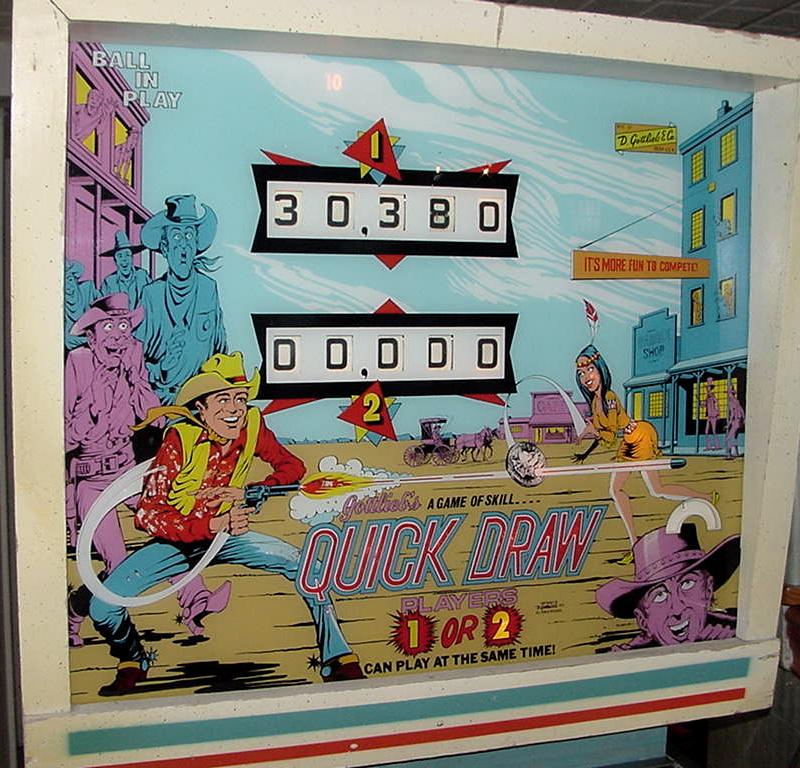

I don't remember my exact high score on this machine, but I rolled over the counters on at least one occasion.
Pictures from here.
During my senior year of high school, the Minute Man hamburger joint and teen hangout near my house installed Battle Tanks, an early arcade game where you shot wireframe polygons at other wireframe polygons shaped like tanks. Pyramids and squares provided cover. Quarters flowed like water as I sought to master this new and wonderful genre. But video games were still rare and expensive conversation pieces, and pinball ruled for several more years.
It was a Sunday night about five years later, in what they would now call a sports bar on Northwest Highway in Dallas that I sat down at the coffee table version of Pong that heralded the coming revolution. Within another year I owned an Atari 2600, and the future ex and I spent countless hours jousting, repelling space invaders, destroying asteroids, and responding to whatever other challenges came along. I'm pretty sure Missile Command is the primary cause of the chronic pain in the back of my left hand.

Real char-broiled burgers with grated cheddar and BBQ sauce.
And a back room full of pool and pinball. What more could a teenage boy ask?
Picture from here.
A couple of years later I was managing a community center in a bedroom community, and talked the powers that be into installing a video arcade. The idea was that it would keep the kids in the center after school instead of them being on the street, and would generate much needed income. I spent the better part of four years mastering Donkey Kong, Tron, Galaga, and twenty or thirty more "classic" arcade games.
I managed to kick the habit for a couple of years, mostly due to constant relocation, even more constant working, and a lack of disposable income. The next revelation came in 1988 when we brought home a Packard Bell 500 XT computer with a screaming 8 megahertz processor, 14" amber monitor, and a giant 20 mb hard drive. The machine came with Wheel of Fortune and Jeopardy games loaded, which kept the now-very-soon-to-be-ex occupied, but my life changed (again) for good when I bought a copy of Zork** at the local software and dot-matrix printer store. I wandered into dark places and was eaten by grues on many nights until approaching dawn drove me to bed. The richness of a game that presented puzzles to solve, that I could talk to, and that always offered a different adventure in the next round was like a drug to me, and in some ways set the course of my life since I first typed "open mailbox." I had to know how this was possible. How could such a wondrous machine be built?
The years after this road to Damascus experience saw hundreds -- no thousands -- of hours spent with Leisure Suit Larry, SpaceQuest, Aces of both the Pacific and Europe, F-19 Stealth Fighter, Doom, Myst, Riven, LightHouse, Empires, Schism, Fallout, and countless others, driving, flying, solving puzzles, jumping chasms, turning valves, building and destroying civilizations. Through it all, gritty-eyed, sleep deprived, distracted, and various levels of unprepared for my day's activities, I kept my secret from all but those closest to me. I didn't talk about games, go to LAN parties, or join gamer groups. Mostly because I was a grownup. Oh, and the shame thing.
It's been close to ten years since I seriously played a game. I just can't afford to waste 40% of my time on fictitious adventures anymore. And I can't stay up like I used to could.*** But now Fate -- or perhaps the Goliath Corporation -- has rolled a twenty and thrown games into my professional path in a big way. Perhaps I will finally be able to put my enthusiasm to work in some productive way. Or perhaps I will learn why obsessions make bad professions. The one thing I do know is that I'm going to be spending more time than I have in a long time thinking about games.
So wish me luck. And if you see a dragon sneaking up behind me, give a little yell or something.
* This is an institution they had in the olden days that covered grades 7-9. Apparently, it didn't really catch on. The middle school concept came along when I was in 9th grade, but they didn't completely get rid of junior highs in my town for another decade or so.
**You are standing in an open field west of a white house, with a boarded front door. There is a small mailbox here.
*** Sometimes spelled use-ta-could. It's a legitimate Southern word. Look it up.
Subscribe to:
Posts (Atom)