Civilization is all about mediating our baser instincts with layers of ritual and indirection. Let's face it, many (if not all) of our relationships are based on what someone else can do for us, as long as the price is not too odious. But when we strip away enough of the dance to simply trade sex for cash, the veneer gets too thin for most people's tastes.*
Another place the veneer can get pretty thin is the timesheet. From the time I was fifteen, I was compelled to punch in, sign in, or log in at every job I worked, accounting for my time to the minute initially, and later to the quarter hour. Like toddlers getting haircuts, new workers generally find this practice horribly degrading and painful, and it often takes several years for the indignation to fade. This is because they see it for what it is.
After about thirty years of this, I found my indignation returning. I'm sure this is partially because of the type of jobs I was doing, and the accompanying changes in expectations. Dairy Queen paid me $2.50 for every hour that I spent cooking, mopping, waiting on customers, and making out with Nancy Jacuzzi in the walk-in cooler. After I clocked out, they stopped paying me, and I effectively stopped being an employee. They really didn't care much what I did, as long as I wasn't wearing the little paper hat.
Inexorably, job by job, that social contract changed. I was still expected to account for every minute that I was on the job, but employers expected more. Loyalty, concern for company property and welfare, unpaid overtime, appropriate wardrobe, abstinence from certain extra-curricular activities, and "other duties as directed" are routinely expected by employers, with no real change in attitude toward the employee. Admittedly, they pay more than Dairy Queen, but as the punchline to the old joke goes, "Now we know what you are, we're just haggling on price." In the most extreme cases, we essentially rent the best years of our lives to someone else. The final straw for me was my CEO calling on a Saturday afternoon, asking why I had not responded to the e-mail she sent two hours before.
The last four years have been the first of my professional career without timesheets, and it is hard to describe the difference. People still tell me what to do and expect me to be at work, but I feel much more in control of my own priorities and actions. Our focus is on results, not what people do with every minute of their day.
In the end, the real difference is probably inconsequential. I'm still doing what someone else wants in exchange for money. But the extra layer of indirection makes it easier to pretend we are all in it together.
* Mine included, in case you're wondering. On the occasions I've been compelled to visit "gentleman's clubs" for bachelor parties, I generally keep to myself, try not to touch anything, and leave as soon as possible. I think they are the saddest places on Earth. A stripper actually asked me once if I was "afraid of titties." True story.
Showing posts with label money. Show all posts
Showing posts with label money. Show all posts
Wednesday, December 14, 2011

Friday, August 12, 2011
Volatility
If you have a dollar, and you lose ten percent one day, you will have 90 cents.
If you gain ten percent the next day, you will have 99 cents.
If this continues long enough, you will be out of money.
I'm still a little upset at my friend the nuclear engineer and part time financial manager who pointed this out to me.
You're welcome.
If you gain ten percent the next day, you will have 99 cents.
If this continues long enough, you will be out of money.
I'm still a little upset at my friend the nuclear engineer and part time financial manager who pointed this out to me.
You're welcome.
Thursday, October 14, 2010
Black Cats and Black Crowes
When I was a kid, my family had a fireworks stand. And when I say my family, I mostly mean me and my older brother, though the other two kids spent some time there, too. My parents' were the owners of the operaton, but neither of them ever spent a minute in the stand. Their end was being able to tell us that they weren't buying us [insert name of thing we wanted] because we had the fireworks money. Also, my father took as much product as he could carry to put together the fireworks display that ended our big 4th of July party. Which I never got to attend. Because I was working in the fireworks stand. But I'm not bitter. Anyway...
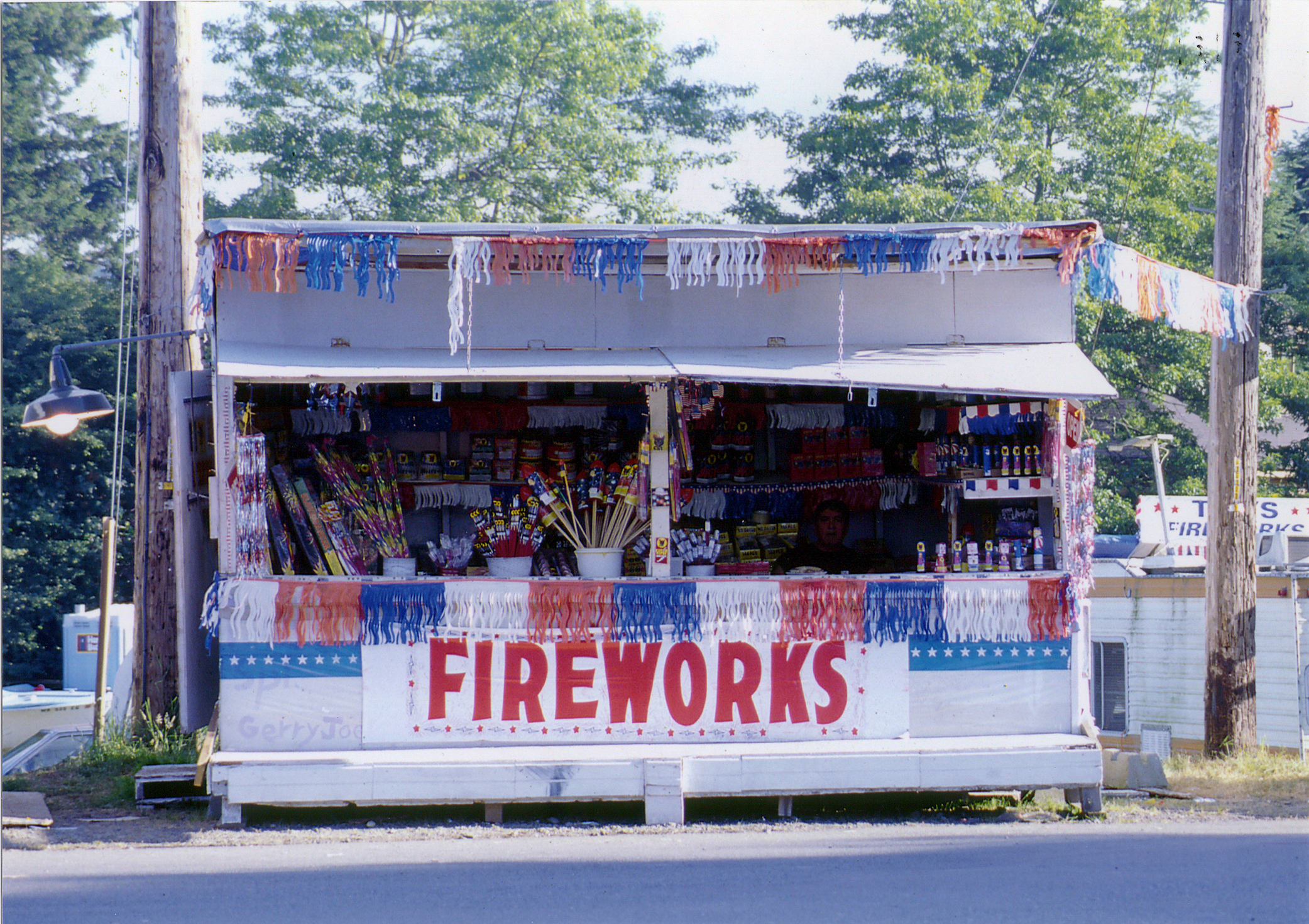
Image from here
We had quite a racket going. Fireworks were illegal to sell within the city limits, but our property and our neighbor's had been surrounded by the city and never annexed. We were on a busy street with good parking and about two miles closer than the next stand. We made several thousand dollars every year during the three week season. Which is not bad for a couple of teenagers during the seventies. Not that I ever got half. Even though I spent the most time in the heat, selling firecrackers to little kids that were raiding their parents' coin collections after spending all of their allowance. My brother got a bigger percentage because he was older. But I'm still not bitter.
The point of all of this is that there were little mom and pop stands like this all over the country, and you don't make that kind of money without attracting some attention from people with more money. So by the time we grew up and got out of the business, the big operations were starting to appear with their buy one, get one free promotions and air conditioning. The easy money disappeared pretty quickly, and the independents along with it.
This is exactly what's wrong with the music industry today. Well, actually what's wrong is that it's the music "industry," which is my actual point. There is so much money in music that the big studios have become music factories, and just like fast food, the secret is to make it just good enough that people will eat it. There is no reason to take a risk, or make anything different, when they have a formula that works. And since they own the distribution channels, there is no way for anyone with an independent voice to compete.
You can see the impact everywhere, though nowhere more apparent than American Idol. I mean, Kelly Clarkson? Really? They can pick an average person with a slightly above average voice, stick them in the machine and a pop star comes out.
I had a show on the college radio station at the second college I attended.* We programmed our own shows, and typically brought a lot of it from our dorm rooms. I'm sure it was terrible, but we enjoyed ourselves, and with a listenership that numbered in the dozens, who cared, really? I was horrified to learn the other day that there is a format called "college radio" now, and that it's just another channel for big factories to market a slightly different version of mechanically separated music.
There is still good, independent music around, if you have the means and motivation to find it. Like food, local is probably best. Personally, it seems I get busier all the time, and hipness is much less important to me than it used to be, so I find myself relying more and more on old stuff. I'm fortunate to still have friends in music who turn me on to new sounds on occasion. Like Bottle Rockets. If you haven't heard them, and you like an unpolished southern rock sound (think Presidents of the United States of America meets Georgia Satellites), spin up some "Welfare Music" and see what you think.
(See how I did that thing with "Bottle Rockets," bringing us back to fireworks? That's literary, is what that is. My English composition teacher would be proud.)
* There were four altogehter.
Monday, October 19, 2009
Pushmi-pullyu
Ben Bernanke gave a speech today about how America's trade deficit played a role in creating the financial crisis, and how once trade starts up again, it will probably go back to playing the same old role, unless somebody does something about it. As for America's part, now that the big banks are back to making money hand over iron fist, the Fed Chairman says we should really work on reducing our budget deficit.
None of this is new or surprising, except when he recommended that Asian nations help by getting their own people to buy their crappy products instead of shipping them to us. Bernanke suggested that one way for countries like China to do this was to increase spending on social programs like education and health care, thereby allowing people to save less and spend more. This is essentially the opposite of what the capitalist crowd would like to see happen in Washington, which makes sense given that we are on the opposite end of the cheap money. Except that many of these same people have talked about how important it is to get Americans borrowing and spending again. Maybe now that so many of the jobs are overseas, we have decided that consumption should follow.
Wednesday, October 14, 2009
The tyranny of things
I have a friend who still has the golf clubs and several pairs of golf shoes that he cleaned out of his late father's country club locker over ten years ago. He holds onto them, despite the fact that the shoes don't fit and my friend doesn't golf. He is not exactly a hoarder, but he has attached feelings to objects and the events they represent in his life to the point that there are definite paths to walk in his apartment. When we were discussing it one time he referred to it as the "tyranny of things."
The Wife and I bought our current home from the three sons of the late owners, who built the house and lived in it for over thirty years. The first time we looked through the house, the daughters-in-law were going through the treasures and trash left behind from full, rich lives lived well, and we heard continual exclamations of amusement and surprise from the attic and bedrooms.
"Wow! There are flashcubes up here! Some of them only have one or two flashes left!" (At no time did anyone discover a camera that could use them.) "How many brooches can one woman wear?" ... "I can't believe they kept all of this."
I have been somewhat fortunate in this regard. I moved a lot when I was younger, and tried to limit my possessions to a volume that would fit in my car. A divorce taught me that we don't miss most of the crap we lose, and five years in a graduate student apartment trained me not to bring anything into the house without looking for something to send out. I adopted a policy of maintaining a fixed space for sentimental objects, and when that space gets too crowded something has to go. On the other hand, I have a lot of hobbies, and I love books, and it turns out that furniture and artwork and clothes and coats and shoes have a tendency to accumulate.
My geographic location and position in the family shield me from a good deal of the "tyranny of heirlooms," though I have received a few of my father's possessions that are really of no use to anyone, but I know meant a lot to him. What am I supposed to do with an architect's seal, or World War II era Army discharge papers? Two separate friends have recently had the experience of going through deceased relatives' houses, and both lamented the things they had to leave behind, knowing that many of their loved one's most treasured possessions would end up with strangers, or in a dumpster somewhere. I don't know if you've ever been to a professionally executed estate sale, but it's not something you want to experience if the estate belonged to someone close.
In my own experience, the times when I had the fewest possessions have been in many ways the happiest. I'm not saying that being poor is better than having money, but that people are better company than things, and that there are many activities more fun and satisfying than shopping and organizing our stuff.
I'm afraid that, in the end, we become the possessions of our stuff. It holds us in one place, both physically and emotionally. A thousand tiny threads bind us to all that we gather around us, and we become like the hermit crab, carrying our lives on our backs. Emotionally, the tyranny of things is associated with everything from severe anxiety to weight gain.
So can someone tell me why we feel the need to glorify materialistic behavior in everything from what we teach our kids to the way we run our society? We judge ourselves and those around us by our possessions, and there is nothing our children desire that they should not have. Consumption-driven economic growth is king, and if you're not buying then you're not doing your part as a citizen. We are supposed to desire and then acquire. Maybe it's good that products are becoming more disposable. I guess if we get used to throwing things away we can work on the front end later.

Image from here
Tibetan monks create complex mandalas from colored sand, often spending days or weeks creating intricate patterns with colored powder to heal and purify the world. The paintings are typically destroyed soon after they are completed, symbolic of the transience of life, and the empty nature of all phenomena. I try to remember this whenever I find myself thinking that I can't get rid of something, or when I set out to clean a closet.
So that's it. I think I'm through with stuff, and I don't need anything. Just this ashtray. And this paddle game, the ashtray and the paddle game and that's all I need. And this remote control. The ashtray, the paddle game, and the remote control, and that's all I need. And these matches. The ashtray, and these matches, and the remote control and the paddle ball. And this lamp. The ashtray, this paddle game and the remote control and the lamp and that's all I need...

Image from here
The Wife and I bought our current home from the three sons of the late owners, who built the house and lived in it for over thirty years. The first time we looked through the house, the daughters-in-law were going through the treasures and trash left behind from full, rich lives lived well, and we heard continual exclamations of amusement and surprise from the attic and bedrooms.
"Wow! There are flashcubes up here! Some of them only have one or two flashes left!" (At no time did anyone discover a camera that could use them.) "How many brooches can one woman wear?" ... "I can't believe they kept all of this."
I have been somewhat fortunate in this regard. I moved a lot when I was younger, and tried to limit my possessions to a volume that would fit in my car. A divorce taught me that we don't miss most of the crap we lose, and five years in a graduate student apartment trained me not to bring anything into the house without looking for something to send out. I adopted a policy of maintaining a fixed space for sentimental objects, and when that space gets too crowded something has to go. On the other hand, I have a lot of hobbies, and I love books, and it turns out that furniture and artwork and clothes and coats and shoes have a tendency to accumulate.
My geographic location and position in the family shield me from a good deal of the "tyranny of heirlooms," though I have received a few of my father's possessions that are really of no use to anyone, but I know meant a lot to him. What am I supposed to do with an architect's seal, or World War II era Army discharge papers? Two separate friends have recently had the experience of going through deceased relatives' houses, and both lamented the things they had to leave behind, knowing that many of their loved one's most treasured possessions would end up with strangers, or in a dumpster somewhere. I don't know if you've ever been to a professionally executed estate sale, but it's not something you want to experience if the estate belonged to someone close.
In my own experience, the times when I had the fewest possessions have been in many ways the happiest. I'm not saying that being poor is better than having money, but that people are better company than things, and that there are many activities more fun and satisfying than shopping and organizing our stuff.
I'm afraid that, in the end, we become the possessions of our stuff. It holds us in one place, both physically and emotionally. A thousand tiny threads bind us to all that we gather around us, and we become like the hermit crab, carrying our lives on our backs. Emotionally, the tyranny of things is associated with everything from severe anxiety to weight gain.
So can someone tell me why we feel the need to glorify materialistic behavior in everything from what we teach our kids to the way we run our society? We judge ourselves and those around us by our possessions, and there is nothing our children desire that they should not have. Consumption-driven economic growth is king, and if you're not buying then you're not doing your part as a citizen. We are supposed to desire and then acquire. Maybe it's good that products are becoming more disposable. I guess if we get used to throwing things away we can work on the front end later.

Image from here
Tibetan monks create complex mandalas from colored sand, often spending days or weeks creating intricate patterns with colored powder to heal and purify the world. The paintings are typically destroyed soon after they are completed, symbolic of the transience of life, and the empty nature of all phenomena. I try to remember this whenever I find myself thinking that I can't get rid of something, or when I set out to clean a closet.
So that's it. I think I'm through with stuff, and I don't need anything. Just this ashtray. And this paddle game, the ashtray and the paddle game and that's all I need. And this remote control. The ashtray, the paddle game, and the remote control, and that's all I need. And these matches. The ashtray, and these matches, and the remote control and the paddle ball. And this lamp. The ashtray, this paddle game and the remote control and the lamp and that's all I need...

Image from here
Sunday, September 20, 2009
Say hello to my little friend

I am possibly the world's worst astrophotographer. In almost a decade of trying, I have managed one fuzzy picture of Venus. Total. In my defense, I live in one of the worst locations for astronomy this side of Venus, there are only about half a dozen nights a year that the conditions are right, my yard is full of trees (less now), and my equipment is ancient. Also, my telescope is old. And I usually have to be drunk for it to seem like a good idea.
But I have resolved to forge ahead, and like virtually all men, I know that if I suck at something it can only be because I have not spent enough money on

This is Ed, my new telescope, doing something we probably shouldn't be watching with my new camera, which has yet to earn a name. Ed probably has a name for it, but I'm not going to ask.
I will probably be subjecting you in the coming weeks to terrible photographs of interesting subjects like a branch of my neighbor's crepe myrtle, or some smudge that I will claim to be some heavenly body or other, so don't say I didn't warn you. Eventually I will mount Ed atop Lex, the older, larger and wiser scope, which is when the really crappy pictures will start.
Oh, and in appreciation of Johnny and Daisy Fae pointing out that I could take a picture of the new camera using a mirror, here you go.

I took this in the side mirror of my car from about forty yards away. As I said, you've been warned.
________________________________
* I said "tool."
Monday, August 3, 2009
Maybe we should have gotten the credit insurance
Last weekend we watched I.O.U.S.A, and let me just say that if you are a citizen of these United States you must watch this movie. I'll wait.
No? Can't find room in your queue between Mamma Mia!, Get Smart, Knocked Up and Season 4 of Weeds? Yeah, I know. It's got pie charts and shit. It's not exactly Transformers. Okay, I'll give you the short version. Our national finances are in much worse shape than anyone will admit, it's getting worse faster than ever, and no one is doing a damned thing about it. And it's not just that you won't have any Social Security when you get old. In some unknown but relatively short amount of time the old rock solid American dollar may become worth about as much as a Columbian peso, which is not much at all. If you happen to see an Arab or Canadian or Chinese person snooping around your neighborhood in the next few years, don't panic. They are probably just checking out their new property.
I don't usually like to talk about politics, because no one wants to argue about the right stuff. But it doesn't really matter what party you're in. These guys pretty much blast everyone since Truman, and the only person who comes out of this looking like he knows what he's talking about is Ron Paul. But I'm still not voting for him. Maybe the craziest part of the whole thing is that they interview like a hundred politicians and none of them even try to deny that it's happening. They all really seem to feel powerless to do anything.
Oh, well. I guess it's always something. Enjoy the rest of Paul Blart: Mall Cop. In the meantime, I think I'm going to call my broker* and tell him to move all my money** to ammo and canned goods. Although Wobbler always recommended coffee and cigarettes, on the premise that you can trade those for anything.
________________________
* I don't have a broker. Though it was a financial advisor who told me the ammo and canned goods thing. He used to date my sister. True story.
** I don't actually have any money, either.
Subscribe to:
Posts (Atom)