When you're a kid, and your parents talk about things that happened twenty, or thirty, or more years ago, it seems like an impossibly long time. Now that it's been an impossibly long time since I was a kid, I find myself saying these sorts of things all the time.*
Large Southern University has been at the center of my life off and on for an improbably long time, given that a younger me once moved 8 times in one year. I found my professional calling there, met my closest friends, learned more than I can even begin to describe. It is as much my home as the house I grew up in.
Later this month I will leave my office for the last time, and start a new adventure in a new place -- one with seasons, terrain, and a single digit student-to-teacher ratio. Biscuit and I will be leaving for the Show Me State, after almost 30 years in Bayou Country. I will be working on a campus that one can see all at one time, after spending most of my life on one that takes 45 minutes to walk across. My new job is 90% teaching, where my current is almost 100% research. I guess what I am saying is, it's going to be different.
I am excited about my new job, and the move. It is closer to family (when did that become a desirable thing?), day trip distance to some of my favorite places, and I love to teach. Did I mention I will be teaching game development? I like games. The town seems nice, and our new house has a garage. And a basement.
As much as I like it when things change, one doesn't live anywhere this long without filling up a life -- at least if you're doing it right. We will miss our friends, and the food, drive-through daiquiri shops, neighborhood parades, Mardi Gras, and much more. Mostly I will miss familiarity. It's good to know where everything is, and the parts of town to avoid when driving there. I've been getting my hair cut by the same person for twenty years (there I go again). This move will mean a new dentist, vet, dry cleaner, and HVAC service company. Restaurants, paint stores, and neighbors all need to be rediscovered and integrated.
Years ago, I was amazed -- and frankly a little concerned -- when my 75 year old father decided to start a new firm. Now I think I get it. Opportunities come when and where they will. We can choose to do what's next, or we can stay planted, clinging to the familiar. For me, it's time for a change. In the words of the immortal Roy McAvoy (Tin Cup), you ride her until she bucks or you don't ride at all.
Wish us luck, and if you're ever in flyover country, stop in for a glass of tea and a shot of white lightning. But definitely call first. I may be out trying to find a front license plate holder.
* Don't even start the "I have underwear older than that" contest. I am simultaneously proud and horrified at how well prepared I am for this game. I really need to clean out my drawers (heh).
Wednesday, July 6, 2016

Monday, October 19, 2015
A world without work?
The Best Boss I Ever Had told me that he liked to hire smart, lazy people from middle class backgrounds. In those days, a middle class upbringing was assumed to come with a pre-installed work ethic and sense of personal responsibility. The intelligence and laziness meant that you weren't particularly comfortable with the work ethic, and would expend enormous effort to find an easier way. Our shop was a wonderland of labor saving innovations and idiot-proofing.
This would not be a completely unfair characterization of Baby Boomers as a group, and I believe we may have ruined the world because of it. To be fair, we didn't start this process by any means, but we certainly accelerated the trend, and we have taught our children and grandchildren to be really good at it.
Take garbage trucks as an example. Not too many years ago, three men rode a giant trash compactor up and down the street, banging cans on the back to make sure everyone was awake. Today in most places, one driver in a truck with a robot arm has replaced that three person crew. The savings are divided between the millionaire who invented the arm, the international conglomerate who built the truck, and the waste disposal company. Oh, and property owners. Everyone with trash to pick up pays less for it than they otherwise would.
This is how free market capitalism has always worked. Someone comes up with a better/cheaper/faster way, and everyone wins. Except people invested in the old system. Omelet something-something eggs, right? The sons of displaced armorers, whalers, and buggy whip makers would adapt or go for soldiers, and civilization marched on, better and stronger.
Unfortunately, the disruption now is so widespread that there is no place left to go. The entire middle class is invested in the old system. Displaced sanitation workers are competing with former factory workers, administrative assistants, shop owners, and bank tellers for a dwindling number of barista openings. Machines are already reading your mammograms, packing and shipping your Amazon order, and approving your loan applications. Within a very few years they will be driving your cars, caring for your children, and yes, making your skinny vanilla chai latte with extra shot and non-fat whip.
PewDiePie owns the most watched YouTube channel on the planet. This real life Beavis makes professional athlete money for doing this. Warning: NSFW. Also, you will probably find this incredibly stupid if you are a grownup with a job.
An old friend calls this phenomenon the robot economy, and you are not going to believe how much it will change the world in the next quarter century. Not only will the garbage truck no longer need the driver, your can will bring itself to the curb. The only real growth sector in the economy now is twenty-three year olds figuring out ways to either eliminate jobs or entertain us. Even that may soon become the work of computers.
So what of work? If you were raised with that middle class work ethic I was going on about, or you watch Fox News, you are uncomfortable with the idea of people sitting around the house watching cat videos, instead of going to an office somewhere to do the same thing. But once there is literally nothing productive left for us to do, what other choices are there? Seriously. Not a rhetorical question.
And then there is the future of money. If we don't have jobs, how can we be good consumers? The opening salvos of this dispute can be seen in today's politics, though without anyone publicly acknowledging the long term structural problem. We have become consumers of information more than things, and today's economy seems to trade in attention, a fixed (and some would say dwindling) resource. Even with free market innovations, this hardly seems like a sustainable model.
I think this is the top economic question of this still-somewhat-new century. More than one war will be fought over what comes next. Fought mostly by computers, of course. The rest of us will probably just do whatever our implants tell us.
This would not be a completely unfair characterization of Baby Boomers as a group, and I believe we may have ruined the world because of it. To be fair, we didn't start this process by any means, but we certainly accelerated the trend, and we have taught our children and grandchildren to be really good at it.
Take garbage trucks as an example. Not too many years ago, three men rode a giant trash compactor up and down the street, banging cans on the back to make sure everyone was awake. Today in most places, one driver in a truck with a robot arm has replaced that three person crew. The savings are divided between the millionaire who invented the arm, the international conglomerate who built the truck, and the waste disposal company. Oh, and property owners. Everyone with trash to pick up pays less for it than they otherwise would.
This is how free market capitalism has always worked. Someone comes up with a better/cheaper/faster way, and everyone wins. Except people invested in the old system. Omelet something-something eggs, right? The sons of displaced armorers, whalers, and buggy whip makers would adapt or go for soldiers, and civilization marched on, better and stronger.
Unfortunately, the disruption now is so widespread that there is no place left to go. The entire middle class is invested in the old system. Displaced sanitation workers are competing with former factory workers, administrative assistants, shop owners, and bank tellers for a dwindling number of barista openings. Machines are already reading your mammograms, packing and shipping your Amazon order, and approving your loan applications. Within a very few years they will be driving your cars, caring for your children, and yes, making your skinny vanilla chai latte with extra shot and non-fat whip.
PewDiePie owns the most watched YouTube channel on the planet. This real life Beavis makes professional athlete money for doing this. Warning: NSFW. Also, you will probably find this incredibly stupid if you are a grownup with a job.
An old friend calls this phenomenon the robot economy, and you are not going to believe how much it will change the world in the next quarter century. Not only will the garbage truck no longer need the driver, your can will bring itself to the curb. The only real growth sector in the economy now is twenty-three year olds figuring out ways to either eliminate jobs or entertain us. Even that may soon become the work of computers.
So what of work? If you were raised with that middle class work ethic I was going on about, or you watch Fox News, you are uncomfortable with the idea of people sitting around the house watching cat videos, instead of going to an office somewhere to do the same thing. But once there is literally nothing productive left for us to do, what other choices are there? Seriously. Not a rhetorical question.
And then there is the future of money. If we don't have jobs, how can we be good consumers? The opening salvos of this dispute can be seen in today's politics, though without anyone publicly acknowledging the long term structural problem. We have become consumers of information more than things, and today's economy seems to trade in attention, a fixed (and some would say dwindling) resource. Even with free market innovations, this hardly seems like a sustainable model.
I think this is the top economic question of this still-somewhat-new century. More than one war will be fought over what comes next. Fought mostly by computers, of course. The rest of us will probably just do whatever our implants tell us.
Monday, July 20, 2015
Die another day
I died on Friday, albeit at a younger age.
A college campus is a time machine. At least once a week I see someone from my youth, un-aged, and unaware of their role in my past. They are typically not exactly as I remember, but seeing a forgotten walk, smile, or turn of phrase will send me instantly back to high school or college, reliving incidents momentous or trivial. One day I was sitting on the school bus with Lisa. A week or so later I was looking into the first friendly face I saw when I started college four decades ago, hundreds of miles from home.
Sometimes they are enrolled in my classes, and I gain insights that I couldn't have had when I knew their older dopplegangers. I have an inkling now why Joey wanted to be a Marine. I can make an educated guess why Vickie always wore that sad face when she thought no one was looking, and why Valerie never dated much.
Once in a great while, they are me. We know from science fiction that it is dangerous to encounter one's past self, though to this point I haven't found it to be a problem. We do tend to work a little harder on these kids, pushing them to avoid the pitfalls that we fell in, or grab the opportunities we let slip away. It almost never works. I think one source of confidence for teachers is that we learn that youth is youth, and the mistakes we made were more or less inevitable. They accompany youth as surely as sagging skin and stray hairs come with age.
Ben was me with a harder life, and was consequently stronger with more scars. Like me, he had wandered a bit in his youth. Like me, a setback had put him on the path that he was seeking all along, and he had nowhere to go but up. He was going to be a college professor, and he would have been a good one.
Ben was my student and my friend. He was my "there but for the grace of God."
Last year Ben started having problems with heartburn and occasional sore throats. The doctors at the clinics he could afford told him to take antacids and change his diet. By the time he put together the money to buy insurance and get proper tests, the clock was ticking on his final half year. He managed to finish his degree, and he was enrolled in graduate school this Fall, but I think we both knew he wouldn't be there.
Ben's story of redemption ended prematurely early Friday morning, and I have been at loose ends since I heard. This is not how his story is supposed to end. Besides being robbed of the triumph he earned, he left behind some people who really needed him to survive. But whether God, the Fates, or simply cosmic dice, I know by now that there is no term in this equation for what we need. We get what we get, and it's up to the survivors to make sense of it.
I suppose the sci-fi writers are right after all. As my father used to say, we learn something new every day.
A college campus is a time machine. At least once a week I see someone from my youth, un-aged, and unaware of their role in my past. They are typically not exactly as I remember, but seeing a forgotten walk, smile, or turn of phrase will send me instantly back to high school or college, reliving incidents momentous or trivial. One day I was sitting on the school bus with Lisa. A week or so later I was looking into the first friendly face I saw when I started college four decades ago, hundreds of miles from home.
Sometimes they are enrolled in my classes, and I gain insights that I couldn't have had when I knew their older dopplegangers. I have an inkling now why Joey wanted to be a Marine. I can make an educated guess why Vickie always wore that sad face when she thought no one was looking, and why Valerie never dated much.
Once in a great while, they are me. We know from science fiction that it is dangerous to encounter one's past self, though to this point I haven't found it to be a problem. We do tend to work a little harder on these kids, pushing them to avoid the pitfalls that we fell in, or grab the opportunities we let slip away. It almost never works. I think one source of confidence for teachers is that we learn that youth is youth, and the mistakes we made were more or less inevitable. They accompany youth as surely as sagging skin and stray hairs come with age.
Ben was me with a harder life, and was consequently stronger with more scars. Like me, he had wandered a bit in his youth. Like me, a setback had put him on the path that he was seeking all along, and he had nowhere to go but up. He was going to be a college professor, and he would have been a good one.
Ben was my student and my friend. He was my "there but for the grace of God."
 |
| Vaya con dios my friend. We will not see your like again. |
Ben's story of redemption ended prematurely early Friday morning, and I have been at loose ends since I heard. This is not how his story is supposed to end. Besides being robbed of the triumph he earned, he left behind some people who really needed him to survive. But whether God, the Fates, or simply cosmic dice, I know by now that there is no term in this equation for what we need. We get what we get, and it's up to the survivors to make sense of it.
I suppose the sci-fi writers are right after all. As my father used to say, we learn something new every day.
Saturday, May 23, 2015
Now what can you do for my aura?
So, last Thursday night I stumbled out of bed in the middle of the night to service a biological imperative,* as is the habit of men my age. My next recollection is of struggling up from the bathroom floor, with Biscuit standing next to me asking what happened.
I had sipped one or three beers and mostly skipped dinner the previous evening, but I really didn't have that much, officer, I swear. With no other explanation forthcoming at 3:00 am, I put it down to low blood sugar and fading stamina, made sure there were no bones sticking out, and went back to bed.**
The next morning I sat up, put my feet on the floor, and immediately fell backwards across the bed. I have experienced bed spins before, but never when it was light outside. I took another run at it, albeit more carefully, and found that once I got upright, things were more or less normal after a minute or so. Any significant change in the orientation of my head, however, sent the room spinning and started the process over.
A quick consult with Google pointed to some combination of stroke, heart disease, diabetes, and possibly a brain tumor. Or inner ear problems, which (spoiler alert!) turn out to be much more common, but don't get as much internet traction. Of course I only ever take ill on Friday. I determined to wait out the weekend, assuming I would either be dead or getting better by Monday. It turns out there was a third option, and I spent the weekend like a drunken sailor in a hurricane, stumbling from one handhold to the next.
I don't have a regular cardiologist or neurologist, as they are expensive and frightening. I do have an ear, nose, and throat doctor, and she has never used the word "catheter" in my presence that I recall, so I went to see her. I think everyone in the office knew what was wrong about five seconds after I walked in, but they are nothing if not thorough, so I got a blood pressure check, another stroke test, a few hearing and ear tests, and a good listen through a stethoscope. Apparently they also have the Google. Right before leaving the room, the nurse said, "She will be in shortly. She's going to align your crystals!"
After eliminating the scary possibilities, the doctor tested me for what she already knew was wrong with me, which is something called benign paroxysmal positional vertigo, or BPPV. Unlike ED or RLS, positional vertigo is not something made up by drug companies, but a real thing that happens to a lot of people. Apparently, tiny rocks (the crystals) in the inner ear wander into a neighborhood where they are not welcome, and the social tension causes a miniature riot when you move your head.
She put me in Bugs Bunny's barber chair, raised me to a height guaranteed to break something if I fell off, and had me lie back and turn my head to the side. If she said "cough" I was out of there, dizzy or not. Instead, she held up a finger for me to stare at, and when I turned to the left and one finger suddenly became three, she said, "There it goes!" with a look like an arsonist at a bonfire.
The treatment turns out to be something called the Epley maneuver. While this sounds like a British military technique that probably involves a bayonet, it's just more lying down, turning the head, sitting up, and getting dizzy. It doesn't fix the problem exactly, but relocates the tiny crystals to somewhere less annoying in the ear until they resorb. Also, I learned a new word. Re-sorb.
I'm pretty much back to normal now, with occasional bouts of walking like a mildly drunken landlubber in normal circumstances when I forget and do something stupid like lie down and then stand up. I haven't tried driving yet. Maybe today. What could possibly go wrong?
* I'm pretty sure this is why they are called the "wee hours."
** Biscuit made me smile and blink, and whatever else you are supposed to do to check for stroke before she would let me go back to sleep. Apparently I passed, or she just got tired.
I had sipped one or three beers and mostly skipped dinner the previous evening, but I really didn't have that much, officer, I swear. With no other explanation forthcoming at 3:00 am, I put it down to low blood sugar and fading stamina, made sure there were no bones sticking out, and went back to bed.**
The next morning I sat up, put my feet on the floor, and immediately fell backwards across the bed. I have experienced bed spins before, but never when it was light outside. I took another run at it, albeit more carefully, and found that once I got upright, things were more or less normal after a minute or so. Any significant change in the orientation of my head, however, sent the room spinning and started the process over.
A quick consult with Google pointed to some combination of stroke, heart disease, diabetes, and possibly a brain tumor. Or inner ear problems, which (spoiler alert!) turn out to be much more common, but don't get as much internet traction. Of course I only ever take ill on Friday. I determined to wait out the weekend, assuming I would either be dead or getting better by Monday. It turns out there was a third option, and I spent the weekend like a drunken sailor in a hurricane, stumbling from one handhold to the next.
I don't have a regular cardiologist or neurologist, as they are expensive and frightening. I do have an ear, nose, and throat doctor, and she has never used the word "catheter" in my presence that I recall, so I went to see her. I think everyone in the office knew what was wrong about five seconds after I walked in, but they are nothing if not thorough, so I got a blood pressure check, another stroke test, a few hearing and ear tests, and a good listen through a stethoscope. Apparently they also have the Google. Right before leaving the room, the nurse said, "She will be in shortly. She's going to align your crystals!"
 |
| My view of the world for much of the last week. |
After eliminating the scary possibilities, the doctor tested me for what she already knew was wrong with me, which is something called benign paroxysmal positional vertigo, or BPPV. Unlike ED or RLS, positional vertigo is not something made up by drug companies, but a real thing that happens to a lot of people. Apparently, tiny rocks (the crystals) in the inner ear wander into a neighborhood where they are not welcome, and the social tension causes a miniature riot when you move your head.
She put me in Bugs Bunny's barber chair, raised me to a height guaranteed to break something if I fell off, and had me lie back and turn my head to the side. If she said "cough" I was out of there, dizzy or not. Instead, she held up a finger for me to stare at, and when I turned to the left and one finger suddenly became three, she said, "There it goes!" with a look like an arsonist at a bonfire.
The treatment turns out to be something called the Epley maneuver. While this sounds like a British military technique that probably involves a bayonet, it's just more lying down, turning the head, sitting up, and getting dizzy. It doesn't fix the problem exactly, but relocates the tiny crystals to somewhere less annoying in the ear until they resorb. Also, I learned a new word. Re-sorb.
I'm pretty much back to normal now, with occasional bouts of walking like a mildly drunken landlubber in normal circumstances when I forget and do something stupid like lie down and then stand up. I haven't tried driving yet. Maybe today. What could possibly go wrong?
* I'm pretty sure this is why they are called the "wee hours."
** Biscuit made me smile and blink, and whatever else you are supposed to do to check for stroke before she would let me go back to sleep. Apparently I passed, or she just got tired.
Sunday, May 10, 2015
Simple happiness
Final exams were last week, and a few days ago I was contemplating a post to bookend the back to school diatribe I wrote nine months ago. It would have detailed the fundamental and visible ways that the end of the academic year differs from its start. The mood on a rapidly emptying campus is a mix of elation and indifference born of exhaustion. There are no novices on campus now, no wasted steps, and virtually no one is in a hurry. Traffic is practically bearable. Summer's oppressive heat has been replaced with Spring breezes.
This is where it all went wrong. By the next day, when I got serious about writing, it was 89 degrees and humid. The magical state of inspiration was shattered. My disillusionment was beyond what the change in weather alone would dictate. I groused like my grumpiest Facebook friend.
I think this is one reason that grownups can't often achieve the same unabashed happiness that kids get out of five minutes on the merry-go-round.* Adults have complicated lives, with too many degrees of freedom in their bliss equations. Kids don't worry about tomorrow, or regret the road not taken. They are zen, unstable and uncaring. The rest of us bind our happiness to innumerable threads of achievement, entangled and often pulling against each other. Food, shelter, career success, happy and well adjusted children, regard of our peers, romantic bliss, must all coexist before we allow ourselves untainted joy. We must scale to the top of Maslow's pyramid to be unburdened, while an 8 year old is good with a hot dog and 15 minutes in the pool.
I am not sure how much of this behavior is learned, and how much is a natural consequence of the way we are wired. There is a lot of gray matter surrounding the happy place in our brain. I'm sure it's there for some reason. And there is definitely a hormonal component. Self doubt and regret seem to come with puberty.
The good news is that I think the capacity for simple pleasure returns with age. Ask an eighty year old what makes them happy, and they are likely to say a good bowel movement, or a day in the garden. Our family gatherings used to devolve into stress-filled group therapy sessions. These days my family laughs through most of our time together. I have watched my mother's happiness threshold for holidays like Mothers Day moderate from -- unachievable, really -- to lunch and a call from her kids.
So it seems there is hope for us all, even my grumpy Facebook friend. Have a simply happy Mother's Day, everyone.
* I realize merry-go-rounds are much too dangerous for today's children. Do iPad games and Disney shows produce the same giggling elation? A question for another day -- and someone with kids -- I suppose.
This is where it all went wrong. By the next day, when I got serious about writing, it was 89 degrees and humid. The magical state of inspiration was shattered. My disillusionment was beyond what the change in weather alone would dictate. I groused like my grumpiest Facebook friend.
I think this is one reason that grownups can't often achieve the same unabashed happiness that kids get out of five minutes on the merry-go-round.* Adults have complicated lives, with too many degrees of freedom in their bliss equations. Kids don't worry about tomorrow, or regret the road not taken. They are zen, unstable and uncaring. The rest of us bind our happiness to innumerable threads of achievement, entangled and often pulling against each other. Food, shelter, career success, happy and well adjusted children, regard of our peers, romantic bliss, must all coexist before we allow ourselves untainted joy. We must scale to the top of Maslow's pyramid to be unburdened, while an 8 year old is good with a hot dog and 15 minutes in the pool.
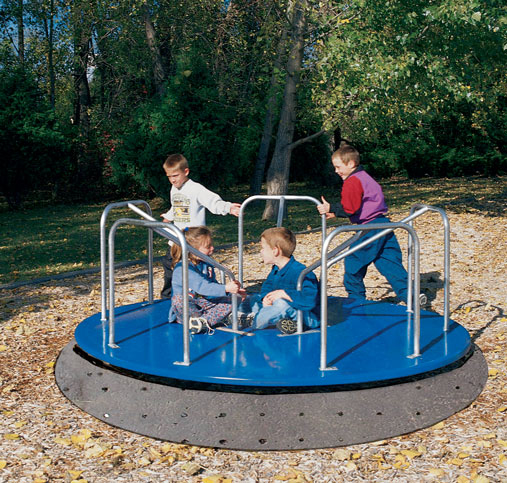 |
| The playground may be rubber, but at least none of these kids are texting. Image from here |
I am not sure how much of this behavior is learned, and how much is a natural consequence of the way we are wired. There is a lot of gray matter surrounding the happy place in our brain. I'm sure it's there for some reason. And there is definitely a hormonal component. Self doubt and regret seem to come with puberty.
The good news is that I think the capacity for simple pleasure returns with age. Ask an eighty year old what makes them happy, and they are likely to say a good bowel movement, or a day in the garden. Our family gatherings used to devolve into stress-filled group therapy sessions. These days my family laughs through most of our time together. I have watched my mother's happiness threshold for holidays like Mothers Day moderate from -- unachievable, really -- to lunch and a call from her kids.
So it seems there is hope for us all, even my grumpy Facebook friend. Have a simply happy Mother's Day, everyone.
* I realize merry-go-rounds are much too dangerous for today's children. Do iPad games and Disney shows produce the same giggling elation? A question for another day -- and someone with kids -- I suppose.
Thursday, April 2, 2015
Life without a laptop
My personal laptop suffered a massive stroke this past weekend. It is not completely dead, at least not yet. It powers on and the little Apple shows up, but not much productive happens after that. I am doing what I can to make it comfortable and save what memories remain, but it's only a matter of time before we pull the life support.
While tragic, this doesn't exactly leave me cut off from the virtual world. I have an embarrassing number of computers and tablets at work, and a few more at the house. But this is the machine that I commune with early in the morning, that keeps me company while I watch TV, and that sits with me when I am sick. It has been my near-constant companion since -- apparently -- mid 2009. Plus, it knows a lot of my passwords.
I have already learned something from the experience, though. I don't have the same relationship with my phone that the young people do, and the laptop has been my go-to device for killing time. Over the years, I have used the big machine more like kids use their phones, as a cure for boredom and an habitual source of distraction. Without it, I feel more focused, and I am spending more time out of my chair.
Much of my professional work involves Tangible Computing, and the Internet of Things, concepts so powerful that they defy explanation. Seriously, I can't explain them. I have been trying for years. What they promise is a future where -- let's say a decade from now -- Google will use your habits at home to adjust the thermostat in your office. They might even tweak the temperature based on what clothes you put on before you left the house. Your coffee cup will tell the robot at Starbucks what you want, and pay for the transaction. Your car may inform you that the restaurant you entered as a destination is frequented by your ex, and there is a 42% chance that they are there. And you won't have to do anything! It will all happen automatically. In fact, you won't be able to stop it.
If you are much over 30, this probably all sounds terrifying and horrible. Much younger, and your attitude is likely to be more positive. Either way, the future is coming, ready or not. The idea of computing as an activity one does with a machine will be as much a part of the past as talking on the phone in a specific room, tethered by a curly cord. The world of Star Trek will be with us much earlier than anyone believed, at least where technology is concerned. The social justice and peace thing will probably take much longer.
What is unclear is what this will do to the way people think. It is possible that technology will sink naturally into the background, allowing us to live a more intentional life. Some of our current research is in this direction, creating environments that change subtly with conditions, the way the sky changes color due to time and weather. Given society's history, it is more likely that our connected environment will attract and manipulate us in ways subtle and profane, and that we will become even more distracted than the kids who walk in front of my car every day, never looking up from their iPhones. Maybe that thermostat will cool the room an extra couple of degrees during the morning, so that I am a little more susceptible to the suggestion of a vente mochaccino.
My intellectual interest is in making sure all of this works together in some reasonable way. If my refrigerator is going to catch me up on my [insert favorite social media platform here] feed, then it damn well better remember what I came into the kitchen to do, because I certainly won't. I think this post is a good example of that phenomenon.
Which brings me to what will have to serve as the point of all this. I am going to fix or replace my laptop, but I don't think I will keep it so close to me. I need to understand this brave new world to the extent I will participate, and my MacBook is no more a part of it than a rotary phone, or cable TV.
While tragic, this doesn't exactly leave me cut off from the virtual world. I have an embarrassing number of computers and tablets at work, and a few more at the house. But this is the machine that I commune with early in the morning, that keeps me company while I watch TV, and that sits with me when I am sick. It has been my near-constant companion since -- apparently -- mid 2009. Plus, it knows a lot of my passwords.
I have already learned something from the experience, though. I don't have the same relationship with my phone that the young people do, and the laptop has been my go-to device for killing time. Over the years, I have used the big machine more like kids use their phones, as a cure for boredom and an habitual source of distraction. Without it, I feel more focused, and I am spending more time out of my chair.
Much of my professional work involves Tangible Computing, and the Internet of Things, concepts so powerful that they defy explanation. Seriously, I can't explain them. I have been trying for years. What they promise is a future where -- let's say a decade from now -- Google will use your habits at home to adjust the thermostat in your office. They might even tweak the temperature based on what clothes you put on before you left the house. Your coffee cup will tell the robot at Starbucks what you want, and pay for the transaction. Your car may inform you that the restaurant you entered as a destination is frequented by your ex, and there is a 42% chance that they are there. And you won't have to do anything! It will all happen automatically. In fact, you won't be able to stop it.
If you are much over 30, this probably all sounds terrifying and horrible. Much younger, and your attitude is likely to be more positive. Either way, the future is coming, ready or not. The idea of computing as an activity one does with a machine will be as much a part of the past as talking on the phone in a specific room, tethered by a curly cord. The world of Star Trek will be with us much earlier than anyone believed, at least where technology is concerned. The social justice and peace thing will probably take much longer.
 |
| I was going to add an image of the inside of a computer, but this seems infinitely more appropriate. Image from here |
What is unclear is what this will do to the way people think. It is possible that technology will sink naturally into the background, allowing us to live a more intentional life. Some of our current research is in this direction, creating environments that change subtly with conditions, the way the sky changes color due to time and weather. Given society's history, it is more likely that our connected environment will attract and manipulate us in ways subtle and profane, and that we will become even more distracted than the kids who walk in front of my car every day, never looking up from their iPhones. Maybe that thermostat will cool the room an extra couple of degrees during the morning, so that I am a little more susceptible to the suggestion of a vente mochaccino.
My intellectual interest is in making sure all of this works together in some reasonable way. If my refrigerator is going to catch me up on my [insert favorite social media platform here] feed, then it damn well better remember what I came into the kitchen to do, because I certainly won't. I think this post is a good example of that phenomenon.
Which brings me to what will have to serve as the point of all this. I am going to fix or replace my laptop, but I don't think I will keep it so close to me. I need to understand this brave new world to the extent I will participate, and my MacBook is no more a part of it than a rotary phone, or cable TV.
Sunday, February 1, 2015
Freeing up a Sunday night
The last football game I attended with my father was a little over 20 years ago on the day after Thanksgiving. The home state Hogs were playing the Tigers of my alma mater in my home town. Dad had two extra tickets, and my brother and I jumped at the chance to see a game with the old man, even though both teams were terrible that year, and the game was essentially meaningless.
The temperature was in the mid-30s with a cold drizzle at game time, and it was raining hard by the end of the first quarter. The game was not going well for the home team, and the situation was plainly not going to improve in the second half. Soaked, freezing, and miserable, my brother and I decided that a hot shower and a cold drink were called for, so at half time we told Dad we were leaving. "All right, then," he growled from under his poncho, showing no inclination to join us. He didn't call us pussies out loud, but it was clearly implied. He stayed until the bitter (30-7) end, and never mentioned the game to us again.
This is a long way of saying that football is important in my family. We all played growing up. My parents had season tickets most years. When other girls were hanging David Cassidy posters, my sister kept an autographed picture of Joe Ferguson on her bedroom wall. I think Archie Manning was on my mother's list. She still watches football every Fall weekend between naps, and both of my brothers are active on the sports blogs.
So it's not a trivial thing for me to skip the Super Bowl. I have watched them all* since Super Bowl -1 (the 1965 NFL Championship game). I saw a few epic games, and more than a few I could have done without. I watched the Packers, Colts, Cowboys, Dolphins, Cowboys again, Steelers, 49ers, da Bears, Broncos, and the rest put it all together and grab the big prize. I suffered with the Bills through four straight Super Bowl losses. I even lived long enough to see my Saints make it to the big dance and win.
I have been falling out of love with big time football for a while now, but I seem to have passed my personal tipping point. It's not just the concussions and other health problems. A lot of people work jobs that are every bit as dangerous for way less than $10 million a year, though when Ditka says the game is not worth the risk, that gets my attention. It's not even the animal abuse, domestic violence, and murders. They select these people for aggressiveness and violent tendencies, then pump them full of drugs and give them more money at one time than most of us would earn in three lifetimes. Am I the only one who is not surprised when some of them don't act like model citizens?
No, the camelback straw for me was watching the Patriots clearly think it was funny that someone caught them cheating. Worse, I found myself laughing along with them.** It seems to have finally dawned on me that the NFL owners not only don't care about the players or the fans, they don't have any respect for the game. Through scandal after embarrassment, the league shoots a big finger at the fans, lights another cigar with a billion dollar bill, and watch the money-machine keep cranking.
I am not trying to start a movement or anything. I expect everyone I know to watch the game, and I wouldn't expect them to choose differently. I know that neither the sponsors nor the league will notice me gone. My personal choices are the only way I have to shape my world, so I am making this one. Who knows, maybe I'll be back next year.
My father loved football for what it taught young men about leadership, teamwork, sportsmanship, and perseverance through pain and heartbreak. He liked how the game brought families together, and gave manly men some way to express emotions. He loved the game itself. I don't think he would like how professional football is being run. He would probably still watch, and while everyone else was standing around eating snacks and discussing commercials, he would be glued to the biggest television in the house, watching every play to the bitter end. But he would definitely grumble about the erosion of respect for his favorite sport.
All right, then.
* I may have missed one or two being on the road or working, but if I did I don't remember, so they must not have been important. I am also a little fuzzy on the particulars of the 1965 NFL Championship game, other than that it was in color.
** I'm not picking on the Patriots especially. I wasn't particularly enamored of Marshawn Lynch's eloquent defense of his personal right to privacy, either. There is not a team in the league with clean hands. New England are just the latest, and their "what's the big deal" attitude is particular galling to me.
The temperature was in the mid-30s with a cold drizzle at game time, and it was raining hard by the end of the first quarter. The game was not going well for the home team, and the situation was plainly not going to improve in the second half. Soaked, freezing, and miserable, my brother and I decided that a hot shower and a cold drink were called for, so at half time we told Dad we were leaving. "All right, then," he growled from under his poncho, showing no inclination to join us. He didn't call us pussies out loud, but it was clearly implied. He stayed until the bitter (30-7) end, and never mentioned the game to us again.
This is a long way of saying that football is important in my family. We all played growing up. My parents had season tickets most years. When other girls were hanging David Cassidy posters, my sister kept an autographed picture of Joe Ferguson on her bedroom wall. I think Archie Manning was on my mother's list. She still watches football every Fall weekend between naps, and both of my brothers are active on the sports blogs.
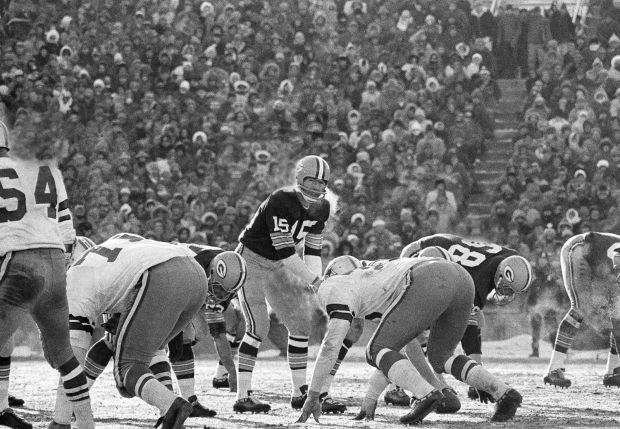 |
| The trouble started when they moved the game indoors. Image from here. |
So it's not a trivial thing for me to skip the Super Bowl. I have watched them all* since Super Bowl -1 (the 1965 NFL Championship game). I saw a few epic games, and more than a few I could have done without. I watched the Packers, Colts, Cowboys, Dolphins, Cowboys again, Steelers, 49ers, da Bears, Broncos, and the rest put it all together and grab the big prize. I suffered with the Bills through four straight Super Bowl losses. I even lived long enough to see my Saints make it to the big dance and win.
I have been falling out of love with big time football for a while now, but I seem to have passed my personal tipping point. It's not just the concussions and other health problems. A lot of people work jobs that are every bit as dangerous for way less than $10 million a year, though when Ditka says the game is not worth the risk, that gets my attention. It's not even the animal abuse, domestic violence, and murders. They select these people for aggressiveness and violent tendencies, then pump them full of drugs and give them more money at one time than most of us would earn in three lifetimes. Am I the only one who is not surprised when some of them don't act like model citizens?
No, the camelback straw for me was watching the Patriots clearly think it was funny that someone caught them cheating. Worse, I found myself laughing along with them.** It seems to have finally dawned on me that the NFL owners not only don't care about the players or the fans, they don't have any respect for the game. Through scandal after embarrassment, the league shoots a big finger at the fans, lights another cigar with a billion dollar bill, and watch the money-machine keep cranking.
I am not trying to start a movement or anything. I expect everyone I know to watch the game, and I wouldn't expect them to choose differently. I know that neither the sponsors nor the league will notice me gone. My personal choices are the only way I have to shape my world, so I am making this one. Who knows, maybe I'll be back next year.
My father loved football for what it taught young men about leadership, teamwork, sportsmanship, and perseverance through pain and heartbreak. He liked how the game brought families together, and gave manly men some way to express emotions. He loved the game itself. I don't think he would like how professional football is being run. He would probably still watch, and while everyone else was standing around eating snacks and discussing commercials, he would be glued to the biggest television in the house, watching every play to the bitter end. But he would definitely grumble about the erosion of respect for his favorite sport.
All right, then.
* I may have missed one or two being on the road or working, but if I did I don't remember, so they must not have been important. I am also a little fuzzy on the particulars of the 1965 NFL Championship game, other than that it was in color.
** I'm not picking on the Patriots especially. I wasn't particularly enamored of Marshawn Lynch's eloquent defense of his personal right to privacy, either. There is not a team in the league with clean hands. New England are just the latest, and their "what's the big deal" attitude is particular galling to me.
Thursday, January 29, 2015
The good craic: Part 3
Sorry, got distracted by the holidays and a conference trip to Palo Alto, which is like Beverly Hills for techies. Wait, different story. Now where was I? Oh, right. We had just left Ballybunion.
The Dingle peninsula was our final destination in Ireland, other than the lovely airport Radisson in Shannon. Normally, by the time vacations are winding down I am ready to get home. I could easily have stayed in Ireland another month, so Dingle had that feeling of last call at a bar that closes much too early.
The drive from Ballybunion to Dingle was predictably lovely, though it did necessitate another trip to Shannon. I was getting the hang of this driving on the left, and Biscuit was getting used to riding a few inches from brush-clad stone walls, so the stress level was down considerably. We wheeled into roundabouts with nary a hesitation. Wheeling out was a bit more of a crap shoot, and we got lost a couple of times, making for some snippy exchanges in the car, but for the most part we had a relaxed trip.
Which was good, because we had decided to take the Connor Pass into Dingle town. I'm not sure why anyone ever chose to put a road through this thing. It's tall and steep and cold and wet and terrifying. And beautiful. Not to be missed if you are in the neighborhood. I don't know what you're going to do if you meet another car on one of the long single lane (even by Irish standards) stretches, but I'm sure you will figure something out.
Given the rapid decline in tour buses since we arrived in Ireland, we were a bit surprised to find Dingle town packed with people. And I mean Disney World, Jersey shore in the summer packed. It turns out we had arrived on the final day of the big Dingle Food Festival. Every building with a kitchen had a table set up where one could line up to buy sample portions of whatever they were featuring that day. We had some pork sliders and Guinness, a few other tidbits and a pint of Murphy's, and eventually a handful of Tums with a pint of Beamish. It was great fun, but four hours was about all I needed of 75,000 people crammed into a town built for 2000, so we were not disappointed that the festival was drawing to a close.
We spent the next morning driving the Dingle peninsula. I can't begin to describe the beauty and history of this place, and there are WAY too many pictures to include here. I will have to let a couple of representative shots be sufficient.
The trip home was blessedly uneventful. I was greatly relieved to turn in the Skoda with no new dents or scratches, and the flights were relatively on time and drama free. We definitely hope to go back to do the east and north of the island someday.
Thanks for coming along. Sláinte!
The Dingle peninsula was our final destination in Ireland, other than the lovely airport Radisson in Shannon. Normally, by the time vacations are winding down I am ready to get home. I could easily have stayed in Ireland another month, so Dingle had that feeling of last call at a bar that closes much too early.
The drive from Ballybunion to Dingle was predictably lovely, though it did necessitate another trip to Shannon. I was getting the hang of this driving on the left, and Biscuit was getting used to riding a few inches from brush-clad stone walls, so the stress level was down considerably. We wheeled into roundabouts with nary a hesitation. Wheeling out was a bit more of a crap shoot, and we got lost a couple of times, making for some snippy exchanges in the car, but for the most part we had a relaxed trip.
 |
| There is a lay-by about halfway up the Connor Pass where one can stop, get some pictures, and change pants, if necessary. The yellow line in the picture marks the edge of the road, not the center. |
Which was good, because we had decided to take the Connor Pass into Dingle town. I'm not sure why anyone ever chose to put a road through this thing. It's tall and steep and cold and wet and terrifying. And beautiful. Not to be missed if you are in the neighborhood. I don't know what you're going to do if you meet another car on one of the long single lane (even by Irish standards) stretches, but I'm sure you will figure something out.
 |
| When we got to Dingle Town, this street and sidewalk were bumper to bumper and elbow to elbow, respectively. By the following morning, things had calmed down considerably. |
We spent the next morning driving the Dingle peninsula. I can't begin to describe the beauty and history of this place, and there are WAY too many pictures to include here. I will have to let a couple of representative shots be sufficient.
 |
| Thatch is a fairly new innovation on the Irish timeline, and the trees have been gone for much longer. Many of the old structures are made entirely of stone, of which there is plenty. |
 |
| One of the nicer roads in the Irish countryside. Most were narrower, and lacked the generous hard shoulder pictured here. The road up Conner pass was about 3/4 as wide, with a sheer wall of rock on one side and nothing but air on the other. Meeting a tour bus coming around one of these curves was quite a thrill. |
 |
| The Gallarus Oratory. It is believed to be a chapel built somewhere around 900 CE, give or take 300 years. They say it is still keeps out the rain, at least as well as it ever has. |
 |
| The small peaks on the horizon are the Blasket Islands. The island population declined through emigration during the 20th century, until last residents were evacuated in 1953. The Blasket Centre was an unexpected high point of the day's tour. Also, it's fun to say "blasket" after a while. |
 |
| Dinner on our last night was at the Dingle Pub. Good traditional Irish food and drink. I think the staff were a bit burnt out from the food festival, but they were efficient and friendly, which is all you can ask. |
Thanks for coming along. Sláinte!
Wednesday, December 24, 2014
Season's Greetings
Merry Christmas! I hope you're not offended that I used the C-word, but in my defense, I am not a particularly religious holiday observer. I attend Christmas Eve church services when we are at one mother's house or another, but this holiday has always been about presents, decorations, family, and goodwill in my book. You show me a day when every store in America is closed,* and I will show you a secular holiday.

I suspect Christmas gains at least some of its power from its ties to the winter solstice and the beginning of a new year. Combining the message of peace and goodwill with the reflection and renewal of year's end creates a potent cocktail of emotion. Evergreen foliage, drinks made from eggs and cakes full of fruit, red, green and gold color scheme -- it's a Technicolor holiday for sure.
Life is a chain -- a line made of circles -- and this is the time when one link is closed and the next begun. Not coincidentally, December and January see more funerals than any other months of the year. (The most births are in August.)
There is comfort in the constancy of the seasons, and a reminder that history repeats, or at least rhymes. Boxing up an old year and opening a shiny new one flavored with Christmas cheer brings a sense of relief and hopefulness, despite the fact that exactly nothing has changed except the date. Our traditions fortify these feelings.
I haven't written as much this year as some others, either professionally or here. I have always been a cyclical journalist, so I am neither particularly surprised nor distressed. Writing for me is inherently reflective, and I have been looking forward and outward this year, acting more than thinking. My career change to academia inspired a great deal of self examination. I feel now like I am finding my identity, and steadily becoming a more competent professional me. My home life is as pleasant and stable as it has been at any time in my life. In short, I am currently too happy and boring to have much to write about.
But life is change, and this year is likely to see its share. A number of potential disruptions are floating about, personally and professionally. Career opportunities, home projects, unexplained rashes. I may buy a new car. And there will be the unexpected gifts from the fates. The quiet times never last forever, partially because I get bored. I try to savor the constancy while it lasts.
I hope you have a great holiday season and a wonderful 2015. Let's be careful out there.
* With the exception of Asian restaurants and movie theaters, of course.
I suspect Christmas gains at least some of its power from its ties to the winter solstice and the beginning of a new year. Combining the message of peace and goodwill with the reflection and renewal of year's end creates a potent cocktail of emotion. Evergreen foliage, drinks made from eggs and cakes full of fruit, red, green and gold color scheme -- it's a Technicolor holiday for sure.
Life is a chain -- a line made of circles -- and this is the time when one link is closed and the next begun. Not coincidentally, December and January see more funerals than any other months of the year. (The most births are in August.)
There is comfort in the constancy of the seasons, and a reminder that history repeats, or at least rhymes. Boxing up an old year and opening a shiny new one flavored with Christmas cheer brings a sense of relief and hopefulness, despite the fact that exactly nothing has changed except the date. Our traditions fortify these feelings.
I haven't written as much this year as some others, either professionally or here. I have always been a cyclical journalist, so I am neither particularly surprised nor distressed. Writing for me is inherently reflective, and I have been looking forward and outward this year, acting more than thinking. My career change to academia inspired a great deal of self examination. I feel now like I am finding my identity, and steadily becoming a more competent professional me. My home life is as pleasant and stable as it has been at any time in my life. In short, I am currently too happy and boring to have much to write about.
But life is change, and this year is likely to see its share. A number of potential disruptions are floating about, personally and professionally. Career opportunities, home projects, unexplained rashes. I may buy a new car. And there will be the unexpected gifts from the fates. The quiet times never last forever, partially because I get bored. I try to savor the constancy while it lasts.
I hope you have a great holiday season and a wonderful 2015. Let's be careful out there.
* With the exception of Asian restaurants and movie theaters, of course.
Sunday, December 7, 2014
Infamy passing
It has been three years since the Pearl Harbor Survivors Association officially disbanded due to the advanced age and ill health of its remaining members. Their dwindling numbers at the commemorations is a tangible reminder that the event that defined my parents' world -- and to a great extent mine as well -- is on the verge of receding into history. Within a decade, or maybe two, all who remember the worldwide conflagration will be gone, or entombed in rapidly failing bodies.
I don't think we can imagine what December 7, 1941 meant to this country. We like to make comparisons to 9-11, and the general idea is probably similar, but the scale of the attack and ensuing conflagration make 9-11 look like a convenience store robbery by comparison. No one said, "Go back to the mall and try to live normal lives" on December 8th. The nation transformed itself in a matter of months into a weapons factory of almost unbelievable productivity. Factories were converted (in many cases literally overnight) from making cars, stoves, or clothing to production of bombers, artillery, and parachutes. Millions of men left farms, factories, and offices to join the fight, and millions more women shed their aprons to replace the men at work, or wear different uniforms.* Everyone was expected to do their part, and those who shirked were labeled bums, or cowards. Roosevelts and Kennedys fought and died with everyone else, though they probably wore better fitting uniforms than most.
More Americans died in an average two-week period -- and on a few unfortunate single days -- than were killed in ten years of fighting in Iraq and Afghanistan. The Army Air Corp (forerunner of the Air Force) lost about 80 heavy bombers and over 600 men in a single raid. Over a million Germans and Russians are believed to have died at Stalingrad alone, and best estimates are that more than 20 million Soviet citizens and soldiers died during the course of the war.
When it was over, much of the industrialized world was in ruins, with the notable exceptions of the United States and Soviet Union. It is no coincidence that those two nations dominated commerce and politics for the next half century. The first salvos of the Cold War were fired even before the war in Europe was concluded, and more than one Allied leader recommended pushing the Soviets back within their borders. If America were not still embroiled in a vicious battle in the Pacific, they might have tried it. As it is, some strategic German cities and facilities were bombed in the closing days of the war expressly to deny them from the communists.
I spent several days recently with a colleague who grew up not far from Berlin. His parents were about the same age as mine, and the war shaped their lives absolutely. The habits they formed were imprinted so strongly that they have not faded to this day. For instance, if there is food on their table it must be eaten before anyone gets up. Leftovers are not a luxury they could afford.
I try to take a few minutes to reflect every year on the anniversary of the attack on Pearl Harbor. (Some years go better than others.) It is a day commemorating sacrifice and war, situated between major American holidays of gratitude and peace. The people who experienced that war learned to be thankful just for living another year. Peace was a tangible goal to work toward, not an abstract concept discussed in church.
The Pearl Harbor generation shaped our world, and our expectations of our world, for better and worse. The world -- and Fox News -- will miss them.
* This surge of responsibility, and disillusionment when it was unceremoniously taken away at war's end, planted the seeds for the Women's Liberation movement.
 |
| Image from here |
I don't think we can imagine what December 7, 1941 meant to this country. We like to make comparisons to 9-11, and the general idea is probably similar, but the scale of the attack and ensuing conflagration make 9-11 look like a convenience store robbery by comparison. No one said, "Go back to the mall and try to live normal lives" on December 8th. The nation transformed itself in a matter of months into a weapons factory of almost unbelievable productivity. Factories were converted (in many cases literally overnight) from making cars, stoves, or clothing to production of bombers, artillery, and parachutes. Millions of men left farms, factories, and offices to join the fight, and millions more women shed their aprons to replace the men at work, or wear different uniforms.* Everyone was expected to do their part, and those who shirked were labeled bums, or cowards. Roosevelts and Kennedys fought and died with everyone else, though they probably wore better fitting uniforms than most.
More Americans died in an average two-week period -- and on a few unfortunate single days -- than were killed in ten years of fighting in Iraq and Afghanistan. The Army Air Corp (forerunner of the Air Force) lost about 80 heavy bombers and over 600 men in a single raid. Over a million Germans and Russians are believed to have died at Stalingrad alone, and best estimates are that more than 20 million Soviet citizens and soldiers died during the course of the war.
When it was over, much of the industrialized world was in ruins, with the notable exceptions of the United States and Soviet Union. It is no coincidence that those two nations dominated commerce and politics for the next half century. The first salvos of the Cold War were fired even before the war in Europe was concluded, and more than one Allied leader recommended pushing the Soviets back within their borders. If America were not still embroiled in a vicious battle in the Pacific, they might have tried it. As it is, some strategic German cities and facilities were bombed in the closing days of the war expressly to deny them from the communists.
I spent several days recently with a colleague who grew up not far from Berlin. His parents were about the same age as mine, and the war shaped their lives absolutely. The habits they formed were imprinted so strongly that they have not faded to this day. For instance, if there is food on their table it must be eaten before anyone gets up. Leftovers are not a luxury they could afford.
I try to take a few minutes to reflect every year on the anniversary of the attack on Pearl Harbor. (Some years go better than others.) It is a day commemorating sacrifice and war, situated between major American holidays of gratitude and peace. The people who experienced that war learned to be thankful just for living another year. Peace was a tangible goal to work toward, not an abstract concept discussed in church.
The Pearl Harbor generation shaped our world, and our expectations of our world, for better and worse. The world -- and Fox News -- will miss them.
* This surge of responsibility, and disillusionment when it was unceremoniously taken away at war's end, planted the seeds for the Women's Liberation movement.
Wednesday, November 26, 2014
The Good Craic (Part 2)
When we last saw our intrepid travelers, they were dealing with an unexpected itinerary change. After leaving the bored, gum-snapping ticket agent at the Aran Islands Ferry office unsatisfied*, we returned to the Doll's Cottage to take advantage of our remaining hour of free wifi and some informed advice. We consulted with Sean and his other guests (a crazy-for-hiking German couple, and a nice American school teacher traveling with her two adult children), and decided we would check out Bunratty Castle and then spend the night at Loop Head, unanimously declared the most beautiful place that no one goes to in Ireland. We set the GPS for Bunratty** and headed back toward Shannon for the second of what would end up being four times.
* No, I mean we left unsatisfied from our visit. Not that she was unsatisfied. Because, well, that's just not going to happen, know what I mean? What? We're not doing phrasing anymore?
** Bunratty is the setting between "stun" and "electro-convulsive therapy".
 |
| Bunnratty is a fully restored Edwardian castle surrounded by historical buildings, livestock, and agricultural machinery. Think Jamestown or Williamsburg, but quite a few centuries older. It is a miracle that we managed to get this picture of the castle with no one in front of it. One of the guides told us that she sees a thousand people on an extremely slow day. They have medieval dinners in the evenings. I think it's blackbird pie and typhus, but I didn't look at the menu that closely. |
After a drizzly but pleasant couple of hours at Bunratty, we made our way to Loop Head via the Coast Road (aka the scenic route). We were bound for a "wonderful B&B" Sean had recommended at Carrigaholt. We were almost there when we realized he had never told us exactly where it was or what it was called. Fortunately, we started seeing signs for a place called Glencarrig B&B. It was getting late, we were tired and a tiny bit grumpy, so it seemed good enough.
It turned out to be better than good enough. Luke and Mary Aston live about a mile from town, and Mary runs the Glencarrig guesthouse for her husband's charter fishing business. Had it been summer we probably couldn't have gotten a room, but in early October we were the only people in the place. The guesthouse is separated from the main house (connected by the dining room), so it was very much like having a cottage to ourselves. Mary recommended The Long Dock for dinner, so we headed back to town.
 |
| The view from our room at Glencarrig. It is hard to believe that this whole country isn't covered with condos. |
Downtown Carrigaholt is three pubs and a stop sign, and we were at the end of a long day. We really weren't looking for much except edible dinner and sleep. It ended up being our favorite night in Ireland. After a relaxed supper of local seafood, Biscuit asked about local music. Live music shuts down with the season in all but the most tourist of towns, but we asked anyway. They sent us next door to Morrissey's Village Pub. There was no music, but before we could turn around the locals called us in, made a spot in the center of the bar, and treated us like long lost friends. We had a wonderful night talking about life in Ireland, life in America, what sort of snacks sheep would like (nuts), big tech companies, fracking, and it gets a little fuzzy after that. We may have had a pint or two too many -- at the insistence (and expense) of the locals.
After a slow start in the morning and a much needed full breakfast, we drove off to see the sights of Loop Head. Once again, the pictures can tell the story better than I.
 |
| The lighthouse at Loop Head. It is every bit as lonely and beautiful as this shot might lead one to believe. |
 |
| The Bridges of Ross. There used to be three bridges, but one fell in the sea. |
 |
| The coast at Loop Head may not be quite as spectacular as the Cliffs of Moher, but it was close, and we didn't see a single tour bus while we were there. |
 |
| The parking lot at the Bridges of Ross. We spent close to an hour there and never saw another person. There were three cows, but I believe they were locals. This was typical of our time at Loop Head. |
Our last stop in Ireland was to be the Dingle Peninsula. We had originally planned to start the drive to Dingle somewhat late in the day from the Aran Islands ferry, so we scheduled an overnight stop in Ballybunion to break up the drive. More gorgeous coast, this time with golf courses. More good food and local music.
 |
| Ballybunion is a golfing resort that is perhaps not as popular as it was before the crash. Consequently, there is plentiful lodging, quite a few pubs (open and closed), and of course beautiful coast, ruins, etc. The women's beach is to the left here, with the men's beach on the right. |
This is getting long again, so I will save Dingle for another day. I assume you quit reading it ages ago, in any case. There is only so much of someone else's vacation that any of us can stomach. Since you won't be paying attention, I'm definitely going to talk about you in the next post.
* No, I mean we left unsatisfied from our visit. Not that she was unsatisfied. Because, well, that's just not going to happen, know what I mean? What? We're not doing phrasing anymore?
** Bunratty is the setting between "stun" and "electro-convulsive therapy".
Wednesday, November 5, 2014
The good craic
Biscuit and I try to take a trip every few years around our wedding date to congratulate ourselves on continuing to put up with each other. This year we chose Ireland as our destination. Biscuit has wanted to visit the west coast of Ireland since she saw The Quiet Man as a girl, and I am all about rocks, ocean, and pubs.
We stayed at Doll's Cottage B&B in Doolin, owned and operated by Sean O'Connor. Sean's parents Gus and Doll had owned Gus O'Connor's Pub, a fixture in town and less than a hundred yards (or "meters") from the B&B. As an itinerant chef and storyteller, Sean is an ideal host, as long as you like to listen and don't mind opinions. We had a blast, and he was very accommodating, even offering us a ride to the Cliffs of Moher to start our hike. The room was generally clean, with a few dusty spots in the corners that let you know it was the end of a long tourist season. This was common with the accommodations on our trip. I had the impression that all would be spic and span again come Spring.
For our full day in Doolin, we walked from the Cliffs (about 3 miles distant) back to Doolin village along the Burren Way. I can't begin to do justice to how simultaneously relaxing and stimulating it was. The weather was grand, and there were sheep and donkeys besides. Combined with the pub experience the night before, this had to be our favorite 24 hours of the trip.
The next morning we were scheduled to travel to the Aran Islands and spend the night on Inis Mór. Unfortunately, we woke to rain and tropical storm force winds, and were disappointed to learn that the ferries would not run "for at least a couple of days." It was by far the biggest disappointment of the trip, and we were left with 36 hours to fill.
Whatever would we do? Could we find something else fun to occupy our time? Would the 2 euro umbrella we bought in Galway survive? How many times would I go to the wrong side of the car before remembering it was right hand drive?
Find out in the next installment of The Good Craic! (This is getting long, and Biscuit is growing tired of me crippling our internet connection uploading gigantic pictures, so I will take up the second half later.)
*Do you love the names of these towns, or what?
We didn't want to spend the whole time in the car, and most Irish roads resemble bike paths, so it was apparent from the start that we wouldn't be able to see the whole country, compact as it is. After a ton of internet research (hers), and a few ill-informed opinions (mine), we decided on stays in Galway, Doolin, and Dingle, with a side trip to the Aran Islands and an overnight stay in Ballybunion.*
The trip was super-relaxing, I didn't hit anything in the Skoda (look it up), and I'm full up on scenery for at least a year. I will let the pictures do (most of) the rest of the talking. We took over a thousand photographs between us, and at least half of them are worth seeing. Here are some of my favorites, with a few shots thrown in for narrative purposes.
Shannon
After a surprisingly comfortable British Airways flight from Dallas to Heathrow, we caught a surprisingly uncomfortable Aer Lingus flight to Shannon, the "other airport" in Ireland. They lost my bag somewhere along the way, and by the time we finished filling out the paperwork, customs was deserted and we walked out of the airport unmolested. After a bit of a wait at the rental agency, we headed off to Galway, with me trying to remember to stay on the left side of the road. |
| Shannon airport from the rental agency car park. There is a Radisson hotel that is actually closer to the terminal than this, out of the frame to the right. We stayed there on our last night in Ireland. As hotels go, it was very close to the airport. |
Galway
We spent our first two nights in Galway at the Park House Hotel. The hotel was well located, with private parking (which we really came to appreciate in Ireland) and helpful staff. My bag arrived about four hours after we did, so I didn't have to spend ten days in the same pants. We were asleep before it was dark both nights, awake through the middle of the night, and asleep again through the morning, which kept our time wandering the city somewhat limited. We did manage a nice drive around Connemara, and even had time to find Nora Barnacle's house.
 |
| Galway is the fourth most populous city in Ireland (75,000 and some), a college town, and a seaport since 1124. The River Corrib flows through the city and into Galway Bay. |
 |
| Did I mention I like pubs? This one is across the street from John F. Kennedy Park, and served the best hamburger I have had in a while. Our hotel was across the street about halfway up the block. |
 |
| It seems about half of Ireland comes here to shop. This area between the park and the sea is restricted to foot traffic for several square blocks. I mostly bought beer. And an umbrella. |
Doolin and the Burren Way
We left Galway on the third morning and drove down the coast to Doolin in County Clare. Doolin is known for traditional Irish music and is very near the Cliffs of Moher, so it's a pretty popular tourist destination. Luckily for us, the tourist season ends on October 1st, and the crowds were fast disappearing. The town consists of a harbor, three pubs and some wool-centric souvenir shops. Since it's too warm for sweaters where we live, we focused on the pubs. We enjoyed some good food, great traditional Irish music (we even tried to dance once), and the best stout I have ever tasted.We stayed at Doll's Cottage B&B in Doolin, owned and operated by Sean O'Connor. Sean's parents Gus and Doll had owned Gus O'Connor's Pub, a fixture in town and less than a hundred yards (or "meters") from the B&B. As an itinerant chef and storyteller, Sean is an ideal host, as long as you like to listen and don't mind opinions. We had a blast, and he was very accommodating, even offering us a ride to the Cliffs of Moher to start our hike. The room was generally clean, with a few dusty spots in the corners that let you know it was the end of a long tourist season. This was common with the accommodations on our trip. I had the impression that all would be spic and span again come Spring.
For our full day in Doolin, we walked from the Cliffs (about 3 miles distant) back to Doolin village along the Burren Way. I can't begin to do justice to how simultaneously relaxing and stimulating it was. The weather was grand, and there were sheep and donkeys besides. Combined with the pub experience the night before, this had to be our favorite 24 hours of the trip.
 |
| The Cliffs of Moher, a breathtaking stretch of coastline. The combination of active erosion, strong winds, and poor survival instincts send a few people over the edge every year. The authorities finally relented and put some barriers in the most heavily trafficked sections. |
 |
| This is reputed to be the landing spot for Harry and Dumbledore in their search for a horcrux. I didn't see the cave, but I assume the entrance is concealed by magic. |
 |
| O'Brien's Tower at the Cliffs of Moher. You can hardly throw a sheep in Ireland without hitting some medieval structure or ruin. |
 |
| The view along the coast toward Doolin village. The village is near the center of the distant coast. The harbor is toward the left of the frame, |
 |
| In case the seaward view isn't holding your attention, this is what the other direction looks like. Biscuit and I talked a lot about what it would have been like to grow up in one of these houses. |
 |
| Donkeys! You can see that they are already walking toward us, hoping for carrots, or beer or something. Also, cow butts. |
 |
| Looking back along a section of the coastal path. As you can see, we have left the barricades far behind. |
 |
| Doolin village. Gus O'Connor's pub is the two story building to the right of the frame. Doll's House B&B the reddish house with the bay window. I think that's Fitz's Bar at the right edge but it was always dark when we were there. And people were drinking. |
Whatever would we do? Could we find something else fun to occupy our time? Would the 2 euro umbrella we bought in Galway survive? How many times would I go to the wrong side of the car before remembering it was right hand drive?
Find out in the next installment of The Good Craic! (This is getting long, and Biscuit is growing tired of me crippling our internet connection uploading gigantic pictures, so I will take up the second half later.)
*Do you love the names of these towns, or what?
Monday, October 27, 2014
Kids are the future
This past Thursday I was privileged to evaluate fifteen or so student proposals to "deliver news to communities using social media." The contest was conducted through the Mass Communication* School, with the winning proposals receiving a cash grant, presumably to help complete the project.
I learned a few important things. First, this group of Mass Comm. students are ambitious, innovative, and as dedicated as one could reasonably expect of 20 year olds. Their proposals were generally well thought out, though they had a blind spot when it came to creating original content, or understanding why commercial entities would not be excited about someone else aggregating their original content for free.
Another thing I learned was the virtues of being able to do everything on one's phone, without ever having to look up, rely on another device, or interact directly with another person. Seriously, I heard this repeatedly, to the point that I was a little frightened. I knew that these kids relied on their phones more than old people believe can be healthy, but I didn't realize that the people shaping tomorrow's media believe heartily that this is a good thing.
Perhaps the most important thing that was confirmed for me was that reading is boring. I heard repeatedly how tedious it was to wade through New York Times articles, long e-mails (with bullet points, no less!), or even verbose Facebook messages. A minute is entirely too long to watch a video. We should be able to put the salient points of any news story into a clip no longer than 45 seconds, and usually more like 15.
I really don't know what this means for our media future, but I know that it seems like what we see will be shorter, more immediate, and more personal than social media and smartphones have wrought to this point. Good luck, young ones.
* What used to the Journalism School.
I learned a few important things. First, this group of Mass Comm. students are ambitious, innovative, and as dedicated as one could reasonably expect of 20 year olds. Their proposals were generally well thought out, though they had a blind spot when it came to creating original content, or understanding why commercial entities would not be excited about someone else aggregating their original content for free.
Another thing I learned was the virtues of being able to do everything on one's phone, without ever having to look up, rely on another device, or interact directly with another person. Seriously, I heard this repeatedly, to the point that I was a little frightened. I knew that these kids relied on their phones more than old people believe can be healthy, but I didn't realize that the people shaping tomorrow's media believe heartily that this is a good thing.
Perhaps the most important thing that was confirmed for me was that reading is boring. I heard repeatedly how tedious it was to wade through New York Times articles, long e-mails (with bullet points, no less!), or even verbose Facebook messages. A minute is entirely too long to watch a video. We should be able to put the salient points of any news story into a clip no longer than 45 seconds, and usually more like 15.
I really don't know what this means for our media future, but I know that it seems like what we see will be shorter, more immediate, and more personal than social media and smartphones have wrought to this point. Good luck, young ones.
* What used to the Journalism School.
Saturday, September 20, 2014
Just words
I feel surrounded by Death,
and the Promise of Death.
Too many dear to me have lost friends,
and mothers, sons, and fathers,
in what seems the space of an afternoon.
Others have been sentenced, and
now they wait.
And I wait with them,
counting under my breath.
I cannot help.
My cup is empty
in the face of such loss.
Their pain overwhelms me.
I fear my own weakness.
My thoughts move unbidden to places where this
much death and more is truly the work
of an afternoon. Families and friends
wiped away, each day after day.
How do they do it? How do they stand?
How can a soul face so much death and live?
Ebola, ISIS, Russian Separatists.
They are only words to me. Pictures on a screen.
But every day they deliver Death,
and the Promise of Death.
Call it tragic.
It is the Way of Things.
These are the
rules of our existence.
So, this is middle age.
Perhaps I should have taken more
risks in my youth, though I am
not sure what else I could have done.
I will recover. I will find my feet.
I will help as I can.
But it won't be today.
Today I am paralyzed by Death,
and the Promise of Death.
and the Promise of Death.
Too many dear to me have lost friends,
and mothers, sons, and fathers,
in what seems the space of an afternoon.
Others have been sentenced, and
now they wait.
And I wait with them,
counting under my breath.
I cannot help.
My cup is empty
in the face of such loss.
Their pain overwhelms me.
I fear my own weakness.
My thoughts move unbidden to places where this
much death and more is truly the work
of an afternoon. Families and friends
wiped away, each day after day.
How do they do it? How do they stand?
How can a soul face so much death and live?
Ebola, ISIS, Russian Separatists.
They are only words to me. Pictures on a screen.
But every day they deliver Death,
and the Promise of Death.
Call it tragic.
It is the Way of Things.
These are the
rules of our existence.
So, this is middle age.
Perhaps I should have taken more
risks in my youth, though I am
not sure what else I could have done.
I will recover. I will find my feet.
I will help as I can.
But it won't be today.
Today I am paralyzed by Death,
and the Promise of Death.
 |
| Image from here |
Wednesday, August 27, 2014
Are you ready for some chaos?
Back to school time is my least favorite season of the year. There, I've said it. It's not that I don't like the approach of Fall. It's my favorite season. And I don't really hate the return of the academic year. I try to appreciate all of my days, valuing each as the gift from Bokonon that it is. Some days are easier than others, but generally I feel pretty good about the results.
But, being on a major college campus during the transition from summer tranquility to the busiest time of the year comes with no shortage of aggravations. Like the first cool breezes that foretell the arrival of autumn*, the precursors show up about a month in advance. Advanced orientation begins for incoming students, and one starts to see guides walking around campus holding large numbered placards, trailing several dozen lost looking former high schoolers, still sporting the latest styles of their home town.
By two weeks before school, college-sponsored camps and programs begin, and traffic around campus starts to pick up. The organized orientation groups are replaced by family groups, the parents regaling their kids with outdated wisdom and stories of past college glory. A short round woman and her short round son** stopped me in the student union a couple of weeks ago, and she demanded to know if there were anything to eat in the building besides McDonalds and Einstein Bagels.
Me: "Sure. If you go through that door there is a place where you can get a built-to-order salad or sushi."
Them: (blank stare)
Me: "Further on there are plate lunches, po-boys, and other sandwiches.
(crickets)
Me: "You will also find Panda Express, Chick-Fil-A, ..."
Her: "OH THANK GOD!"
And they wandered off without another word. This is a pretty typical -- and thankfully not that common -- interaction. For the most part it's people meandering from one side of the sidewalk to the other, or stopping dead in a group in the middle of a hallway, squinting at their phones.

Next comes rush week, generating hordes of identically dressed hopeful Greeks-to-be. The surreality of the whole thing is evident in the array of Hawaiian shirts, jerseys, and whatever other ridiculous garments the participants are required to purchase and wear. This is also when it starts to get hard to get a meal or cup of coffee on campus.
The green flag drops on move-in day, when every street on campus is infested with bumper to bumper Suburbans and U-Haul trailers packed with more crap than will ever fit in a dorm room. Crosswalks become kill zones, and the exhaust from a thousand idling SUVs provides the little extra push to turn the humid August air into toxic steam you can breathe. On the plus side, I am thinking it could give me superpowers.
After a month of this, the actual start of classes is almost a relief. Almost. Traffic now backs up several miles from campus, and every sidewalk and passageway is filled with students in a great hurry, most going the wrong way. I won't leave my office for at least two weeks, and it will be a month or so before Thirsty Thursday infects the rest of the calendar, and attendance drops by a quarter or so. By the middle of October, enough students will have stopped going to class that I will be able to walk the campus again. I might even be able to get lunch if I don't go between 11:00 and 3:00. By February, many will be back in their home towns or working full time at Chili's, and I will be looking forward to summer.
*Which won't actually show up here for another two months.
** Seriously, I thought they might be Weebles.
But, being on a major college campus during the transition from summer tranquility to the busiest time of the year comes with no shortage of aggravations. Like the first cool breezes that foretell the arrival of autumn*, the precursors show up about a month in advance. Advanced orientation begins for incoming students, and one starts to see guides walking around campus holding large numbered placards, trailing several dozen lost looking former high schoolers, still sporting the latest styles of their home town.
By two weeks before school, college-sponsored camps and programs begin, and traffic around campus starts to pick up. The organized orientation groups are replaced by family groups, the parents regaling their kids with outdated wisdom and stories of past college glory. A short round woman and her short round son** stopped me in the student union a couple of weeks ago, and she demanded to know if there were anything to eat in the building besides McDonalds and Einstein Bagels.
Me: "Sure. If you go through that door there is a place where you can get a built-to-order salad or sushi."
Them: (blank stare)
Me: "Further on there are plate lunches, po-boys, and other sandwiches.
(crickets)
Me: "You will also find Panda Express, Chick-Fil-A, ..."
Her: "OH THANK GOD!"
And they wandered off without another word. This is a pretty typical -- and thankfully not that common -- interaction. For the most part it's people meandering from one side of the sidewalk to the other, or stopping dead in a group in the middle of a hallway, squinting at their phones.

Next comes rush week, generating hordes of identically dressed hopeful Greeks-to-be. The surreality of the whole thing is evident in the array of Hawaiian shirts, jerseys, and whatever other ridiculous garments the participants are required to purchase and wear. This is also when it starts to get hard to get a meal or cup of coffee on campus.
The green flag drops on move-in day, when every street on campus is infested with bumper to bumper Suburbans and U-Haul trailers packed with more crap than will ever fit in a dorm room. Crosswalks become kill zones, and the exhaust from a thousand idling SUVs provides the little extra push to turn the humid August air into toxic steam you can breathe. On the plus side, I am thinking it could give me superpowers.
After a month of this, the actual start of classes is almost a relief. Almost. Traffic now backs up several miles from campus, and every sidewalk and passageway is filled with students in a great hurry, most going the wrong way. I won't leave my office for at least two weeks, and it will be a month or so before Thirsty Thursday infects the rest of the calendar, and attendance drops by a quarter or so. By the middle of October, enough students will have stopped going to class that I will be able to walk the campus again. I might even be able to get lunch if I don't go between 11:00 and 3:00. By February, many will be back in their home towns or working full time at Chili's, and I will be looking forward to summer.
*Which won't actually show up here for another two months.
** Seriously, I thought they might be Weebles.
Monday, August 11, 2014
The Research Abides
Our Center hosts a two month research program every summer for thirty or so undergraduates, and a lesser number of high school students and teachers. It's a surprising amount of work for those of us who volunteer as mentors, but is also a fair amount of fun, and always satisfying. The students come from all over the country, from colleges of all descriptions.
My mentat this summer is a student from our school who just finished her freshman year. She is intelligent, ambitious, overprivileged (drives a nicer car than I do), and reminds me of my favorite philosophy professor's observation that, "no one on Earth knows more than a college sophomore." She had a great time and tied for first in the poster competition, but that's not important right now.*
We built a rapport, since she exudes the insecurity inherent to being nineteen and I am generally awesome. During one of her daily drop-ins to my office she mentioned that I had acquired a nickname among the summer students. She said something about her mentor, and several of the students replied, "You mean Jeff Bridges?" She is too young and normal to know which of his roles had likely inspired the comparison, but I knew immediately. I guess there are some things we really don't live down.
* And don't call me Shirley.
My mentat this summer is a student from our school who just finished her freshman year. She is intelligent, ambitious, overprivileged (drives a nicer car than I do), and reminds me of my favorite philosophy professor's observation that, "no one on Earth knows more than a college sophomore." She had a great time and tied for first in the poster competition, but that's not important right now.*
 |
| I do all of the grocery shopping. Image from here. |
* And don't call me Shirley.
Thursday, May 15, 2014
Finding your passion
This is commencement week at Large Southern University. Young people around campus are busy gluing glitter to their mortarboards, figuring out how to conceal booze under their gowns, planning their graduation blowouts, and realizing that they should have been looking for a job already.
The last time I cared about who was speaking at commencement was my own graduation, but I am sure whoever it is this year will exhort the new graduates to "follow your passion." I remember a news story published last year that centered around this universal commencement advice. One new graduate, concerned that he had not yet found his one true calling, sought advice from an economist about what to do. As our young protagonist pointed out, some people find their passion early in life, while others search for decades, or forever. (Spoiler alert: this is another area where economists were sure they could provide an answer, but in the end were as clueless as the rest of us.)
I could have been the poster boy for the (vocationally) passionless. After abandoning uninspired attempts to live up to the potential that people constantly told me I possessed, I drifted through several careers, pursuing goals of the moment, and prone to fits of depression. I realized later that my problem was not that I didn't have a passion. The problem was (to quote a friend) that I felt like a raging failure because I didn't have a passion, and everyone else had one. Didn't they? A lot of my friends had Volvos and college degrees, so I assumed they had driving ambitions.
The first days of Spring of the worst year of my life found me unemployed, almost unmarried, far from friends and family, and an unwelcome guest in my own house. I loathed myself, my life, and my prospects more than I have at any time before or since.* By the time my birthday rolled around I had divorce papers,** a crappy apartment, a crappy sales job, a few pieces of donated furniture, and an old station wagon with a slow leak in the right rear tire.
By the Fall I was back in school, and working odd jobs to pay the bills. My apartment was still crappy, but I had a new tire, and designs on the hot girl at the opposite end of my building. I had also stopped worrying about finding my passion. I was so busy trying to survive, and working to accomplish my next objective, that I really had no time for self-absorption. I was content with the satisfaction that came with learning something new, acquiring a new skill, or making a new friend. I learned to enjoy my own company again, and to appreciate the days as they passed.
Along the way, I fell in love with computer science. I realized that my passion had always been learning new things, understanding how the world works, and thinking hard. CS is a perfect fit. It's not that I only care about computer science because I stopped worrying about my passion, but I do believe that focusing on what I have and enjoying who I am, rather than what I wish I had or who I would rather be, has made it easier to stay committed and enthused. Corny, I know, but no worse than "follow your passion."
* Much better now, thanks for asking.
** Served on my actual birthday. The ex claimed it was an accident, but my lawyer was certain it was intentional.
The last time I cared about who was speaking at commencement was my own graduation, but I am sure whoever it is this year will exhort the new graduates to "follow your passion." I remember a news story published last year that centered around this universal commencement advice. One new graduate, concerned that he had not yet found his one true calling, sought advice from an economist about what to do. As our young protagonist pointed out, some people find their passion early in life, while others search for decades, or forever. (Spoiler alert: this is another area where economists were sure they could provide an answer, but in the end were as clueless as the rest of us.)
 |
| Follow your dreams, no matter what others tell you. Now put on this identical garb and line up to receive a certificate of your worth as a person. Image from here. |
I could have been the poster boy for the (vocationally) passionless. After abandoning uninspired attempts to live up to the potential that people constantly told me I possessed, I drifted through several careers, pursuing goals of the moment, and prone to fits of depression. I realized later that my problem was not that I didn't have a passion. The problem was (to quote a friend) that I felt like a raging failure because I didn't have a passion, and everyone else had one. Didn't they? A lot of my friends had Volvos and college degrees, so I assumed they had driving ambitions.
The first days of Spring of the worst year of my life found me unemployed, almost unmarried, far from friends and family, and an unwelcome guest in my own house. I loathed myself, my life, and my prospects more than I have at any time before or since.* By the time my birthday rolled around I had divorce papers,** a crappy apartment, a crappy sales job, a few pieces of donated furniture, and an old station wagon with a slow leak in the right rear tire.
By the Fall I was back in school, and working odd jobs to pay the bills. My apartment was still crappy, but I had a new tire, and designs on the hot girl at the opposite end of my building. I had also stopped worrying about finding my passion. I was so busy trying to survive, and working to accomplish my next objective, that I really had no time for self-absorption. I was content with the satisfaction that came with learning something new, acquiring a new skill, or making a new friend. I learned to enjoy my own company again, and to appreciate the days as they passed.
Along the way, I fell in love with computer science. I realized that my passion had always been learning new things, understanding how the world works, and thinking hard. CS is a perfect fit. It's not that I only care about computer science because I stopped worrying about my passion, but I do believe that focusing on what I have and enjoying who I am, rather than what I wish I had or who I would rather be, has made it easier to stay committed and enthused. Corny, I know, but no worse than "follow your passion."
* Much better now, thanks for asking.
** Served on my actual birthday. The ex claimed it was an accident, but my lawyer was certain it was intentional.
Monday, May 12, 2014
The mother of all days
When I called my mother yesterday and asked her how Mother's Day was treating her, she replied, "I'm having a wonderful day. I have all my children here with me, except one."
This is hardly a first for my mother. It is actually an improvement over all the years we drove hundreds of miles to be home for Christmas, only to hear, "It's just a shame Eldest Brother couldn't be here." A double-edged guilt sword that would make any mother proud, it admonished Eldest Brother for his absence, while letting the rest of us know that our presence wasn't quite enough to make this one count.
One of the blessings of growing older is that these too revealing pronouncements amuse us now. They are almost a family tradition. This sort of thing frustrated me greatly when I was younger. The worst years were those when I was old enough to see clearly what was being done to me, but powerless to stop it, despite the fact that it had been years since I had needed to borrow money from my parents.
Now I feel the years counting down, and I know that too soon I will have only memories. On the occasions that my siblings and I gather we will reminisce about our years as decorations in my mother's holiday tableaux. And we will miss her.
Be nice to your mama whenever you can manage it. She gave you everything you will ever have. If you don't believe me, just ask her.
This is hardly a first for my mother. It is actually an improvement over all the years we drove hundreds of miles to be home for Christmas, only to hear, "It's just a shame Eldest Brother couldn't be here." A double-edged guilt sword that would make any mother proud, it admonished Eldest Brother for his absence, while letting the rest of us know that our presence wasn't quite enough to make this one count.
One of the blessings of growing older is that these too revealing pronouncements amuse us now. They are almost a family tradition. This sort of thing frustrated me greatly when I was younger. The worst years were those when I was old enough to see clearly what was being done to me, but powerless to stop it, despite the fact that it had been years since I had needed to borrow money from my parents.
Now I feel the years counting down, and I know that too soon I will have only memories. On the occasions that my siblings and I gather we will reminisce about our years as decorations in my mother's holiday tableaux. And we will miss her.
Be nice to your mama whenever you can manage it. She gave you everything you will ever have. If you don't believe me, just ask her.
Subscribe to:
Posts (Atom)